I’m a historian of American eugenics. The only power I’ve ever wanted is the ability to control US History and English lit courses in this country. So many things are left out that we are doomed to repeat again because we don’t know that they happened.
@greenwitch:
There is a haunting song in the musical “1776” about the slave trade (sung by John Cullum, what a voice!), and it talks about the hypocrisy of the triangle trade and slavery in general, and one of the final lines is “I give ye Boston, and Charleston, who stinketh the more?”. A lot of the slave traders were from New England and many of them were very pious, yet they saw nothing wrong with making a buck off of selling human beings. History courses often make it seem like the civil war was the abolitionists up north forcing the south to get rid of slavery, yet the idea that the south seceded because the north was going to free the slaves, which is the way the history books I had in school seemed to imply, is basically untrue, the abolitionists were a minority even at the outbreak of the civil war up north, and Lincoln himself would have kept slavery to maintain the union, in that way the south seceding was more about the fear of abolition then the reality…on the other hand, that doesn’t make slavery any less horrible than it was, and some of the textbooks being written for places like Texas that imply slavery wasn’t so horrible, that “10000 slaves fought for the confederacy, so slavery couldn’t be that bad” (which leaves out a)that they were promised freedom for themselves and their families if they fought and b) that 180,000 black soldiers fought for the union, and many of them were ex slaves, doesn’t sound to me like people who enjoyed it).
It is funny, textbooks talk about the Triangle Trade, but it is this diagram showing ships going to Africa with bibles and rum, ships coming back with slaves, ship leaves the caribean and down south with Molasses and run and cotton, and then it starts again.
Funny part is, I think that controversial views should be in a history class, so they can be discussed and shot down. Holcaust denial? It can be shot out of the water in about 20 seconds. Slavery was this thing that actually benefitted the slaves? Point out the cost of it and its legacy that people are still paying the price for (what I would really love to see is a history book that points out that the poor SOB who fought for the south was impoverished and hurt by slavery, but they ended up de facto fighting for it, yeoman farmers can’t compete against slave labor). The only way to bust myth is to bring it to light of day and bury it in facts…and yes, that the north wasn’t exactly an angel when it came to the slave trade, Britain when they finally banned slavery not only did that, they actively swore to purge the high seas of the slave trade and they did, whereas the US, well, even after 1808, looked the other way as new slaves were imported into this hemisphere (the British, when they caught a slave ship, hung the captain and crew on the spot, and rightfully so).
Let’s get to the fundamental point that almost, literally, torpedoed the Constitution and foreign of the United States government - there would have been no need for the 3/5th’s compromise to get the South to remain as part of the newly formed United States, if slavery was to be part of the Northern States.
Additionally, for the Constitution to be ratified, the Northern States demanded that slavery, in the South, be phased out and the Constitution expressly gave Congress had the right to outlaw it in the South after 20 years.
Without this power for Congress to totally eliminate slavery, for the Northern States, and the 3/5th’s compromise, for the Southern States, were deal breakers for the Constitutional Convention. Thankfully, both the North and South knew that the nascent nation could not survive as separate entities.
Interesting - you would like this power, but in previous posts you complain when others have legally petitioned school boards to get rid of erroneous information and literature? So what you really mean is good enough for you, but not for others? Thanks for clearing that up.
The above post is exactly why banning factual US History and well-written literature is a very bad thing, as it lets people control others by hiding truths they do not like or agree with. Additionally, the controlling of historical facts makes it possible for others to openly lie to the populous.
Hm… if a tree falls into forest and no one hears it, does it still make a sound? I guess based on your theory of how you would like to run education, i.e., control US History ad literature and hide things from people, the answer would be the tree makes a sound only if I tell others it does.
Anyone, who sees the need to control the factual underpinnings of history and the need to control the rather spontaneous recordings of history from various viewpoints which IS the true power of literature, must be very insecure in their beliefs and must know what he believes is so weak that he could not convince others to follow him/her using logical arguments.
You are in interesting company thinking this control is needed to get your beliefs/viewpoints out there, as the former Soviet Union (including Castro and other regimes as well) did exactly that. The very first act they did after their revolutions (well, after killing their dissenters) was rewrite the history books and burn any literature, which did not comport to the State’s view. It was so successful that 99% of the history students in the US do not know that prior to the revolution Russia was a devout Christian nation. Even many high school teachers today teach as if it was always a secular, atheist nation. However, some of the most beautiful Christian churches in the world are in the former Soviet Union.
Banning what people can read, say, and express is quick way to become irrelevant in their lives, especially when hey know you are lying and what you say doesn’t apply to them. And, given what is happening in the country, I do think this ignoring is well underway and growing.
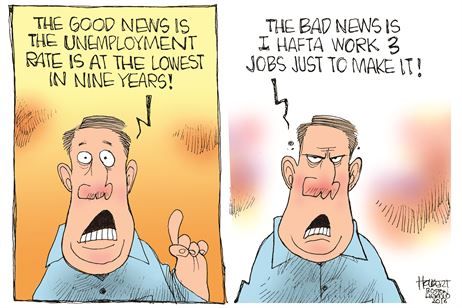
Here is a simple, but excellent example of why facts matter and why facts/viewpoints should not be controlled and be the purview of any one group.
Just imagine if government, public schools or controlling other were only allowed to determine facts and viewpoints, then they would only print the information in the left-hand pane that they believes benefits them.
However, the right-hand pane is also a fact. More importantly, the right-handed pane information truly illustrates where and how too many people actually live and breathe.
And it goes without saying, many people have decided the right-handed pane is unacceptable, even though both panes of information are true - both true, yet viewed very differently by different people living in the same country.
http://media.townhall.com/Townhall/Car/b/holb_c14690320161205120100.jpg
I read @romanigypsyeyes post as saying she would like to control these areas so ensure that all the viewpoints are out there. That is basically what the second line says. I think you interpreted her post incorrectly, though I’ll let romanigypsyeyes be the final word on that.
But who is the final arbiter of what the “facts” actually are? Posters have advanced statements on this thread as fact that are contrary to what historians say. So who gets to decide what is published as “fact?”
@myjanda is awctdb talking about my post? I do not see his/her posts (by my choice) so I’m not sure what s/he’s saying.
My point was that if we talk about the dark areas of US History, we generally limit them to the very distant past or make it seem like the very distant past. We don’t talk about the tens of thousands of involuntary sterilizations and euthanasia advocacy in the 19th, 20th, and now 21st centuries. We don’t talk about how the Nazis modeled their eugenics program on ours. We don’t talk about the fact that children were held involuntarily in boarding schools until the 1980s. We don’t talk about how we continue to trounce on and ignore treaties made with Indigenous peoples. Most schools don’t talk about the Japanese internment camps. We don’t talk about the gross violation of civil rights during the red scare.
The list goes on and on. We only talk about how we were the valiant victors in the world wars. We talk about “liberation” and the like.
Because we ignore these parts of the past, we are doomed to repeat them. Think about the discussion of creating a “Muslim registry” or forcing Muslims to identify themselves in some way. Our president elect constantly tweets out policies that are a gross violation of our first amendment (not to mention many others) but he is correct in that we have committed these violations before. And since we have, we will do it again because we don’t remember that it’s been done.
And I think it does a disservice to our young people- I’m talking high school age- (and not to mention the adults that they grow in to) by suggesting that these topics are above them or that they need to be shielded from them. They deserve to understand their country, its history and its legacy in order to ensure that we do become a “more perfect union” and be the liberators and bastion of freedom that we so desperately claim to be.
@awcntdb :
“Let’s get to the fundamental point that almost, literally, torpedoed the Constitution and foreign of the United States government - there would have been no need for the 3/5th’s compromise to get the South to remain as part of the newly formed United States, if slavery was to be part of the Northern States.”
Slavery was part of the northern states, but the thing you are dodging around is it was never common, the north, unlike the south, never based their economy on slave labor (I am leaving out the slave trade itself or things like buying goods from the slave states). The 3/5 compromise came about because the south wanted slaves to be counted fully in the census, for the obvious reasons this would increase their political power by giving them additional electoral votes and representatives. The northern states that allowed slavery had so few slaves that they would have wanted slaves not to be counted because allowing that would overwhelmingly benefit the south. The 3/5 was a compromise in between the south, who wanted all their slaves counted (and remember, the number of slaves was larger than the free population), and the north who wanted them counted not at all, it gave the south a much larger clout than it otherwise would have ha d but not as much as if fully counted. There are a lot of reasons the slave economy never really took hold in the north, mostly it was because those who settled there didn’t want the competition from slave labor, the farmers and tradesman had more of the political power there, it wasn’t the de facto aristocracy of the south, so it would have been very difficult to develop a slave economy up north.
There is also the fact that the south was bankrupt and they could have used the financial screws to get the south to agree to the banning of slavery. Without the US taking over the debt of the states, the southern states by themselves would have been in deep, deep trouble, and it was leverage they could have used, it is one of the criticisms of Washington, that given his own ambivalence about slavery, had he pushed to get it outlawed (phased in likely), it very well could have happened (Ellis in his bio of Washington mentioned that, as did Gary Nash in his book about the revolution).
“Additionally, for the Constitution to be ratified, the Northern States demanded that slavery, in the South, be phased out and the Constitution expressly gave Congress had the right to outlaw it in the South after 20 years.”
In article 1, section 9 it forbid the outright banning of slavery (interesting, the wording doesn’t mention slaves, it talks about allowing people into the state or not) until 1808, but it did allow taxes and tariffs for bringing them in. It obviously didn’t require that slavery be banned, only gave them the right to do so (in other words, they kicked it down the road). Turned out the only thing that happened in 1808 as far as I recall was that they did agree to forbid the importation of new slaves, which by that point was meaningless, the old slave states like Virginia were making a lot more money selling slaves into new areas then they did in raising crops, so banning importation was good business for them.
I think this does point out how badly history is taught, though, for example we have the strict constructionalists who claim the constitution to be this document set in stone, or those who view it as this perfect document, when this is a classic example of how muddy a document it was, full of compromises and also deliberately leaving things vague (not mentioning slaves directly, for example), the history taught of the revolution is fraught, and I agree with @romanigypsyeyes about teaching it, that the narrative that is taught in US history is so simplified and whitewashed (literally), that it makes the founding seem like this thing ordained from on high rather then just how fraught it was, and how skeptical the founders themselves were of the idea of ‘the power of the people’ and how many elements of elitism and aristocracy were in effect coded into the constitution (and not necessarily for bad reasons, but when I hear people talking about ‘voice of the people’ and ‘majority rules’ being the law of the land, it tells me they learned squat).
Facts are difficult. “The sky is blue” is an accepted fact only if we have a common definition of blue. This seems to me why we just talk past each other so often.
I don’t ever imagine history as a collection of facts.
@romanigypsyeyes :
The ability of a country to examine its past, warts and all, is one of the best ways to prevent horrors from happening, and when you refuse to reconcile with the past, you see the problem. For example, I have heard/read a lot of people mythologizing the great depression, how it really wasn’t so bad, how people were these hardy stock who pulled together (unlike the whiners of today, of course), how it would have taken care of itself, and that is dangerous, because then it frames the discussion of how you deal with similar problems that happen or where/when the government should be involved and so forth. People look at the horrors of the Nazis, and put it in the context of 'that could never happen here", yet similar concepts of race for example were not exactly unknown in this country, there were all kinds of prominent people making policy based on notions of ‘inferior’ races , IQ tests were originally based from what I recall on ‘proving’ the intelligence of the ‘white race’ for example. People talk about the anti semitism of Nazi Germany, but then leave out that there were serious proposals on the table to allow the Jews to leave Germany (at that point Hitler and the Nazis didn’t care as long as they were gone), but the virulent anti semitism in this country among far too many doomed that…but I doubt they teach that in US history classes, because that would muddy the narrative that the US somehow was this saint and angel that defeated the Nazis (not to mention the complicity of the government and business in allowing the third Reich to do what it did).
I think the classic example of this can be seen in how Japan and Germany dealt/deal with the secondd world war period, the Germans to this day make sure that their people know of that past, almost to the point of it being a fetish, they don’t hide anything from the kids in school, it is brutal and honest about what the country did, and they don’t make the excuse it was the Nazis, they point out the problems with anti semtism and racism that underlied what the Germans did. Japan in contrast hides from it, they basically blame everything on everyone else, talk about China as if it was a defensive action and totally ignore the atrocities and in the end make Japan into a victim rather than the cause of the consequences including the atomic bomb. Their textbooks whitewash it, and someone like Abe (the current PM) and his party are advocates of maintaining this party line.
Is it because people do not remember, or because they want to do it again even with the known drawbacks?
I don’t know, ucb. All I know is I’d always error on the side of giving more information rather than less and currently we give close to zero.
I think I understand @romanigypsyeyes point, and it isn’t that she would want to keep anything out, but rather, include things that often are not part of history classes. For example, it is all great and good talking about how bad the Nazis were with eugenics and their Ubermensch crap, but it leaves out that it wasn’t exactly an unknown thing in this country, either, some of the earliest proponents of birth control often did so to keep people of ‘inferior races’ (that often included southern Europeans, Eastern Europeans, Irish, etc in that category) from ‘breeding in numbers’. Certainly something like the Tuskegee experiment, which I don’t recall being talked about in history classes in high school, where federal researchers deliberately didn’t treat or tell the men involved, poor black sharecroppers, that they had syphillis. This went on from 1932-1972, so we aren’t talking the 19th century, and in scope and horror of what they did to those men it isn’t any different than what Mengele and others did in Nazi Germany. We hung and jailed people for these kind of experiments done in the camps, but none of those involved in this horror were ever prosecuted. You can’t even say “well, what they did wasn’t against the law”, we established a standard with the Nuremberg trials, presided over by a Supreme Court justice, that such medical experimentation was a crime against humanity, yet the study continued on 25 years after Nuremberg…what is even more pathetic is the excuse for this used was “the knowledge gained was such that you have to consider its value”, people made that argument for leniency against those who did such things at Nuremberg, and it was shot down (on the other hand, those responsible for the Japanese horrors never faced prosecution, because the US said that their data was ‘invaluable’.).
We have a history that still to a certain extent teaches that native Americans were an obstacle to ‘progress’, that in effect white men made this country great, that the ideas that created the US constitution came from European thinkers (when it was heavily influenced by the Iroquois articles of confederation), all kinds of voices and viewpoints and plain history has been literally whitewashed over it IMO. No, I don’t agree with those who want to demonize the founders or underplay the value of what they left behind, as imperfect as many things were, they left behind something different and unique IMO and that is not totally negated by issues like being slaveholders, but that doesn’t mean they need to be deified either or ignore others. History is often taught as ‘facts’ to be digested and regurgitated, with relatively little thought to the how or whys.
Yes. We can talk about our role in WWII but our current curriculum often limits it to “we freed the Jews” and ignores our role in causing the Holocaust. (Just one example)
I want more, not less. I want nuance. I don’t want the whitewashed, sanitized history we currently have.
I can’t think of any books I’d ban but that doesn’t mean I’m reading all the books, especially if I have read enough to find the author objectionable. Authors have no right to readers. They still get to write even if no one will read them
edit
@alh:
The beauty of free speech, or books, is we can choose to read them or listen to it or not, and do what we may with them. I don’t agree, for example, where some countries have made books denying the holocaust illegal, I would much rather the books be published and given their due course of disdain and anger and being shown what we think of it. I didn’t think Harry Potter books (or the movies) were particularly good for younger kids, but I would also leave that up to the parents to decide, and I certainly wouldn’t want the books banned or removed from the library, there are plenty of books in my local library I wouldn’t give house room to and some of which I find offensive, but I think that a library has a duty to stock books of all kinds, too.
@romanigypsyeyes :
While I would not agree with the idea of the US or the west ‘causing’ the holocaust per se, I would totally want taught that the US and the European countries allowed that to happen, and primarily because they thought that Hitler was a better ally than Stalin and saw Hitler as a “Christian Leader” of a “Christian country” as a bulwark against the evil soviets…and as a result turned a blind eye, and when countries, especially the US, could have done something to stop that evil, they didn’t, for a variety of reasons (there is a wonderful book, well, not a light one, about the first years of the Nazi regime seen through the eyes of the US ambassador “In the Garden of Beasts”, where Hitler was very, very sensitive to criticism of his regime, and instead of openly criticizing him, countries told their ambassadors to not report on what they found and were forbidden to talk about it, the movie industry was encouraged not to make movies that showed Germany in a bad light, etc). I think it is better to say the Holocaust wouldn’t have happened if the US and other European countries had stood up to Hitler, and that the US especially did next to nothing to help with the plight of the Jews, and it wasn’t that they didn’t know how bad Hitler was, they knew, Churchill knew, it was one of the reasons he was with the opposition party against his own conservative party, he saw the folly of it (then, too, of course, we have another thing that has been whitewashed, how many of the “America First Movement” and the like were pro Nazi. There used to be the American Bund movement, they had camps in Northwest NJ, and a lot of local people up there belonged to it. About 30 years ago a couple of teenagers found metal boxes with records of their members, and to this day it is under lock and key at a museum in Newark, researchers can gain access to it only if they agree not to release any of the names, to protect the family members who still live in the area…).
Someone once asked me why I wanted to look at the dark side of US history, and I said because while the US is most definitely not perfect, we do have some unique things, and one of the things we do have is for all the ills, there are always people of good will trying to right the wrongs, or seeing those wrongs repeating themselves, willing to fight against it happened again, and open education and discourse is how these things come to light, and it also stops the idiotic notion that any country, let alone the US, somehow is above the base and horrible things that countries and their people do. I think my wife is finally starting to realize this, we have been watching a tv program about the possibility that Hitler escaped to South America, and in this you see how many did get away and how the allies, especially the US, basically let horrible war criminals and the like disappear, in large part because they didn’t want to embarass the countries in South America taking them in, because of the cold war and other reasons.
I didn’t say the US caused the holocaust. I said we ignore our role in causing it. There is a difference.
The Nazis literally based their eugenics program on the one here. The multi-prong approach originated here. There were communications back and forth between Americans and Germans with the Germans asking advice and the Americans lamenting how successful the Nazi program was compared to ours.
Would the Holocaust have happened without the US’ eugenics program? Probably. But we can’t ever truly know alternative history paths.
Anyone remember the Tom Lehrer song “Werner von Braun”? Is true that the US government snapped up Nazi scientists after the war to do Cold War work?