I am always glad that we bought our 2024 Nissa Ariya EV now, while I am young enough to learn all the bells and whistles. I love the Birds Eye view when parking, the heads-up display on the windshield , automatic headlights and windshield wipers, the driver seat moving back to help you get out of the car, the side mirrors folding in when you leave the vehicle(which lets you know that you didn’t forget to turn off the engine! ask me how I know…  ) but I have had a little trouble getting the cruise control going correctly. The system alerts me when the speed limit changes and I can push a button to adjust the control to that new speed..but I am still figuring that all out. There are almost too many options!
2 Likes
Reading this thread, it seems that it could be a good idea to time that new car acquisition for a time when you’ll drive a lot – so you can “train” yourself on all the bells and whistles, using them enough that you remember how they all work.
It’s so irritating to know a feature exists – because you’ve used it – and not be able to find/set it again!.
3 Likes
With all of the features, sometimes the control is buried in a bunch of touch screen menus, and sometimes it is a button hidden in plain sight in a sea of other buttons.
4 Likes
lol. I relate to this quite a bit.
Twice this week I’ve discovered new functions on my vehicle that I bought in June.
I plan to have this car for many years, but clearly I need to examine every niche of this car in my garage one afternoon.
1 Like
My H is figuring out the controls on his new car, which are different from the ones on the loaner he used while they were applying a coating on his car. I’m sure he’ll figure out the ones he cares about (having the seat go back when he’s ready to exit the vehicle & having mirrors go in so they don’t get hit by folks passing by or parking nearby). He’s enjoying learning so far. I have not tried driving his new car as it’s still HIS and I’m happy to let him explore.
2 Likes
Today we had our 10K maintenance visit (“free” with purchase, though we did a 5k oil change on our own). The loaner ended up being almost the same car, including exterior color. However it was missing some features we have, convincing us that (for us) they were worthwhile splurges.
-
Digit rearview mirror - even my tall husband missed it, grumbled about the rear headrests blocking the view. (Workaround is possible - we have friends who had similar issue on a different car and simply removed the rear headrests. Like us, they rarely have rear passengers.)
-
Light colored interior - neither of us likes all black leather (or immitation leather) seats… and today’s hot weather reminded us of that.
The car did have a lot of other bells and whistles we like. Admittedly we are now spoiled. We do hope to keep this car a long time, so I’m glad we both like it.
1 Like
Audi of America, which imports each vehicle it sells in the U.S., is implementing some hefty price increases across its portfolio for the 2026 model year as the German luxury brand grapples with tariffs.
The price increases for 2026 range from $800 to $4,700, depending on model and trim, and come amid a U.S. sales slump at the Germany luxury brand.
3 Likes
Car prices hit nearly $50,000 for first time as vehicle costs surge | Fox Business
Americans Are Falling Behind On Car Payments Like It’s 1992 All Over Again | Carscoops
1 Like
My car is paid off next summer (I took a many years loan to ensure I could handle the payments so it’s been a looong time coming). I have just over 70k miles on it (thank you Covid or it’d probably be at least 100k thanks to move to virtual meetings at work). I assume I’ll keep it for at least another 70k, maybe another 100k miles which will probably take even longer as I drive less each year. That means I’ll own this car more than 15 years. I assume many others will do the same at these prices. Wages have not even close to kept pace for most people. But tell me again how Elon musk is worth a trillion dollars. At 100,000k per year it would take 10,000 years to earn a billion dollars - a trillion is too many zeros for me to even contemplate.
3 Likes
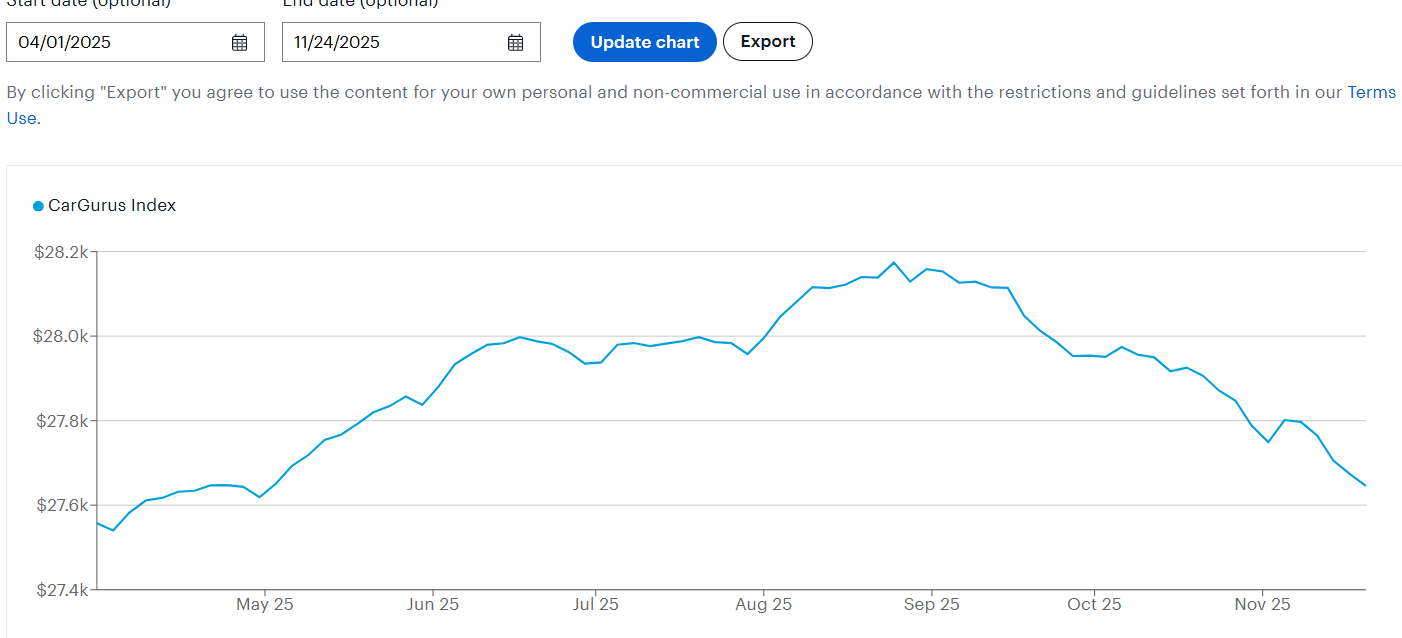
The CPI inflation report paints a different picture, with a less than 1% year over year change in aggregate price of new vehicles, and a small decrease in aggregate new vehicle prices since this thread started in April. CarGuru used car prices also show relative little change. Their aggregate index is pictured below.
I suspect the difference is the CPI calculation compares specific car models – how did the price of car model x change over the past year? While the $50k KBB figure is average transaction price, without considering car model. Said differently, people are more likely to buy higher end car models than last year, rather than prices of same car model increasing. This is consistent with other metrics of the economy suggesting overall spending is being more driven by wealthy persons than in previous years.
1 Like
I read auto news daily and it’s stayed flat just below $50k but my company sends us articles each day so I included. Today it shows $49,911. Down .5% from April 1. But the article shows otherwise. Which source is correct ? OEMs have tried to hold but some can’t due to tariffs.
I know loan defaults are up and I know many OEM captives are turning down marginal buyers. Many are losing many millions a month from loans made during the COVID era.

Auto News Daily uses a different computation method from KBB, so prices do not match exactly. It’s my understanding AND uses an aggregate of list prices - discounts across all car models, KBB uses an aggregate of average transaction sale price across all car models, and CPI uses how transaction sale price has changed from previous year when controlling for the same car models. AND new car price history is pictured below:

It has also been the case that, over the past several years, many companies have discontinued lower cost models without replacement.
2 Likes


Yes, that was what I was alluding to. Planet Money had a podcast on consumer spending and K-shaped economy a few days ago. Some quotes are below:
MALONE: Uh, fair point. Anyway, OK, look. A few things in addition to this, like, insulation factor have also been going really well for people at the top. So, like, this year, their wage growth has been strong. For low-income households, though, growth has been slow.
PATKI: That’s an important resource that supports spending-- paychecks. So that is another factor. And finally, you have changes in wealth. Homes, stocks-- these kinds of assets have become more valuable in the last five years, and they’re likely to be much more important in supporting consumer spending for households at the top of the income distribution.
GONZALEZ: Yeah, people who own homes, their homes have been appreciating in value in, like, wild ways in recent years. And then people who have stocks-- the stock market is doing really, really well. And that gives wealthier people the confidence to spend even more generously.
…
ATWATER: Oh, so the epidemic had barely hit, and economists were predicting how the recovery would take place. And so you had those saying, oh, it’s going to be a V-shaped recovery. Everybody’s going to do well. Others said, no, no, no, we’re going to have this long, pronounced decline, and then it’s going to move up, so it’ll be like the letter U. Others thought it was hopeless, and it was just going to be an L. And I was like, no, it’s going to be K.
…
ATWATER: You know, we-- today, we have twice as many car models that cost over $100,000 than cost less than $30,000. Those driving used cars on the highway see that every day. And so the overabundance at the top is incredibly visible and demoralizing.
GONZALEZ: Peter says we have a bifurcated economy. Basically, there are two different economic experiences existing simultaneously.
MALONE: And companies are focusing on investing in their higher income consumers, like giving them incredible credit card perks, while low-income consumers are defaulting on their credit card debt. The average price of a car right now is $50,000, while car loan defaults and repossessions are on the rise.
1 Like
OK. Brought my 2014 BMW 335 GT with sports package in for an oil change and general checkup. Leaks in the oil pan and elsewhere. Estimated repair cost is $15K. So, time to replace it.
I love my car but they stopped selling it a few years ago. What I love about this car are 1) handling/braking; 2) extended hatchback shape that enables me to carry lots of stuff to Florida or from Costco but also makes it comfortable for adults over 6’ to sit in the back seat (not true of regular BMW 3 series); c) incredibly comfortable drive and passenger seats (making the Florida and Montreal and Toronto drives easier); and d) I would like to get a PHEV if one exists but not a full EV as I want to make the longer drives without waiting to charge.
Consulted ChatGPT and Gemini to find comparable cars. If I don’t want to upgrade in pricing (they suggested Porsches and Audi A7 or S7 that were well above $100K), they recommended:
-
BMW M440i with X-drive. Similar to what I have but body shape not as useful for storing stuff or rear seat but handling, braking, and seat quality the same. Lots of technical complexity and no PHEV.
-
Genesis GV70 3.5T. Very good seats; excellent on storage though not as good on rear seating; good on handling/braking with adaptive suspension models but not as good as BMW (surprise). Less technically complex and better warranty.
-
Volvo V60 with Polestar engineering. Excellent braking. Very good, very aggressive handling. Even better seats than BMW. Good on storage. But even more technically complex. PHEV available but adds to complexity. Also it turns out that Volvo is discontinuing wagons and replacing them with SUVs that don’t handle nearly as well.
All definitely above $50K.
ChatGPT said that if I’m not driving that aggressively, I would be happier with the Genesis. Interesting as I did not know about this car. I’m going to test drive the Genesis and also the BMW.
I also asked it which dealers are best for a) service; and b) valet service (picking up my car and dropping it off when repairs are needed).
In the past, I have had my EA call and ask if they would commit to the valet service if I purchased the car from them. (BMW dealers all said yes; Audi no). Then I would solicit prices and then ask the dealer I liked best to match the lowest offer. I think I will try to use AI for this. I found one called Car Edge. $49/mo but I will only use it for a month. I may try it once I’ve picked car and trim. It does show me that the Genesis models have been on dealer lots for a long time. Not so true of the BMWs. I’m guessing more dealer flexibility on pricing. I will enjoy the experiment.
I normally keep my cars for 10+ years. I’m guessing that this is my last car before we end up with self-driving cars (and I no longer care about handling).
1 Like
Seems like $15k is much less expensive than the new cars you listed that do not do all of the things you like about your current car well.
It does look like the Volvo V60 is the best match of the new cars you listed
4 Likes
It is a shame that no current cars meet my needs as well as my current car. It could be that if I were prepared to pay $120K, I could meet those needs. ShawWife says, “You get such joy out of you cars. You should get something that you really like.” But, I can’t see spending that much money. Before I bought the BMW, ShawWife observed that in our affluent friend group (as opposed to our artist friend or other friend groups), there was a surprisingly high percentage of the husbands who either had an affair and replaced their wives with a younger model or bought a sports car. ShawWife encouraged me to get a red Porsche, but I’m too practical and got a silver BMW.
I wish I could just buy a new version of my current car. Replacing it makes sense because the market value of my current car is about $10K if all is working decently so it seems like the right time to replace it. (And, other stuff will go wrong as well). My rule of thumb has been the replace the car when the repair costs for a year will exceed the amortized cost of a new car. Without negotiation, these cars range from $62K to $80K. If I keep the car for ten years, we are talking about $6K to $8K per year amortized over 10 years.
Nothing on the market is as good as what I have. I agree that tge Volvo is off target. Not going to look. Also, the BMW beats the Audi in this category. So I will just test-drive the two cars. Neither has PHEV but I don’t commute to work so my mileage is lower. When we replace ShawWife’s car, it will probably be full EV.
1 Like
Drive a non-Tesla EV if you can. You might change your tune. They are sooooo responsive and fun to drive. Newer EVs fast charge in 15 minutes.
3 Likes
Regarding the time cost of charging an EV on longer drives, it depends on how often you stop for human purposes (rest, food, toilet, etc.). If you drive ten hours without any stops, then recharging an EV would add time cost. But if you stop for 15-20 minutes every two hours anyway, then doing so where there is fast recharging may mean no added time cost.
2 Likes