I have heard that if the college is relatively close (say 100 miles or so or less) then there is somewhat of an expectation that you’ll visit them in person if they look at demonstrated interest. So after doing the online legwork, it might be worth visiting to demonstrate interest if they’re close by.
OP appears to be in Alaska.
In some ways, for the geographic diversity, schools will have more interest in OP (assuming a stud) than OP will ever need for the school.
1 Like
During Covid, a lot of kids chose their college sight-unseen. My younger kid did, although we live in an urban area with a lot of colleges so he had been on campuses before for high school programs, concerts, summer programs for high schoolers, etc. So he had a general idea of what a campus culture sort-of was, but no visits at all as part of his actual application process..
1 Like
Thank you all for your advice. We are in Alaska — and not on the road system — which is why visiting is so logistically tricky as well as expensive. There’s a couple steps of travel needed to get to where a jet can depart from. My kid said she was for sure the most rural at the rural kid MIT fly in. I do understand that we’ll need to pull off that trip 4x/year for each kid when they do go to school, but that’s a very different calculation than jetting across the country for a few days.
But I do want to do the best I can for them, trying to make sure they end up somewhere they are happy.
My oldest is torn on the large vs. small school question at the moment, but I’m not sure how well a visit could answer that, or what the best way is to answer that, since it doesn’t have to do with the size of campus. Basically wonders about the tradeoff between having lots of class choices in areas of interest vs. having small classes with more professor interaction.
5 Likes
Just because a school is large doesn’t mean it will have large classes, at least once you get to the major.
On the other hand, some small schools have large classes, depending on how you determine that.
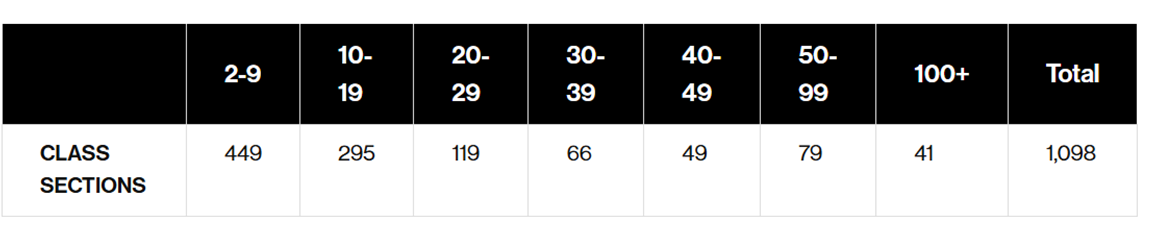
You can go to the common data set section set section I3 to see class size and distribution. It doesn’t tell you by subject, of course, but gives you an idea.
This is U of Louisville - 17K undergrads - a lot more smaller classes than you’d think. I put MIT below that (in the black boxes). Plenty of large classes. 16.1% of their classes are 40+ vs. 15.4% at MIT - so not a true difference even though MIT’s enrollment is less than 1/4 the size.
Ultimately, budget will drive your decision - right? Who will pay?? Sometimes those kids don’t have a say in the matter - as the offers will direct you where you go.
If the student is fortunate enough to get another fly in, you might see if they might allow them to expand the trip a day - you might have to sign a waiver and ask them for housing. When I went for my MBA, UIUC flew me in - and let me know if I was unhappy, I could bail early. I was 27-28 so it was different - but I was miserable on campus, so left and drove to Indiana U (which I loved).
Point being - if they can extend somehow a day, maybe they could get to another campus as well - perhaps they could arrange transport or housing with the other campus - so like when they were at MIT, would it have been possible to get to Northeastern or BU.
Perhaps it’s not plausible - just thinking out loud.

My D went to a large flagship and had plenty of interaction with her professors. It’s not necessarily a trade off your child will need to make.
Many large schools have honors programs and living learning communities that also make a large school feel smaller.
4 Likes
If a school of interest is one where demonstrated interest of a potential applicant is important to the school, then that is an argument for an in-person visit before applying; but you can figure out those schools ahead of time, and plan accordingly.
One thing that was useful for both of my kids in having in-person visits was that they got to see what the actual student body was like, and got an idea whether it was a student body that they wanted to be a part of. Certainly going to a school on an “admitted student day,” after application and acceptance, can help answer that question as well; so if you have logistical issues in visiting campuses in person, then I would consider only a campus visit after admission (your Option 4).
I vote for visits only if financially feasible. If not, I wouldn’t stretch to make it happen prior to applications unless there is a potential ED on the horizon. For the time being, I’d suggest many virtual visits, despite their shortcomings. I’d consider saving for one or two visits in April of senior year. (I say all this having been on >20 visits with my kids; big family.)
2 Likes
Class size may not be the only criterion for closeness to faculty. At MIT, for example, there is an ethos that if a student wants to talk with a professor, the professor makes time regardless of how busy or important they are. One of my friends, who ran a major center there, would always make time. Not the same at Harvard, as far as I can see. I have seen a professor at one NESCAC school allot an hour a week to a very bright freshman who had a conflict with office hours. Would not happen at MIT or Harvard except possibly if they were supervising research and probably not even then.
1 Like
Many schools will have large classes during freshman year — the into classes that everyone needs to take — and then smaller classes as you progress in your major and or have already taken the pre requisites. I believe this will be true at many, if not most, schools regardless of their size.
3 Likes
In regard to travel options, here is an off-the-wall question: would it be possible to go over spring break and then stay a bit longer, and have your kids be in school from this current location rather than their home? I know lodging can be expensive, but some AirBnBs might be less money if you stay longer –and my family has even stayed at youth hostels to save costs, if that is something you would consider. And then you could potentially fit in some extra visits during the school week or the following weekend. That is of course assuming that the accompanying parent can be away from home so long – or that your kid is mature enough to stay on their own for a few days/week while the parent returns. Or if the kid is mature enough for that, can they go visit on their own during spring break and save on travel costs that way? (Do be careful that your spring break doesn’t coincide with the college’s spring breaks, as that makes for very different tour experiences than when college is in session). Based on personal experience, I would recommend the Boston area for having so many different types of schools within easy reach. Los Angeles might be another option, but lacks the public transportation ease of Boston — but perhaps an easier destination for you from Alaska. USC, UCLA, Pepperdine, Loyola, Occidental, Chapman, the Claremont Consortium, Cal Poly Pomona, etc, with UCSB, UCSD, and USD within a few hours drive as well.
On another note, you note that your student hasn’t taken the SAT yet. Has she taken the PSAT? If not (due to logistics), are you aware that for students for whom PSAT logistics area a problem, NMSQT offers an alternate pathway to qualify for National Merit consideration. If she qualifies, this may open some doors for her both in terms of admissions and merit scholarships. If you are interested, google National Merit alternate entry.
2 Likes
There are many aspects to the large-school experience. A few that come to mind…
Which school matters. At some such as MIT the faculty make a point of being available to undergrads. At my large public it did not seem that way, and in fact one prof told us very directly on the first day these are my office hours, I don’t want to see you darkening my doorway any other time.
Choice of major matters. Some have many small classes upper-division or even past the intro classes (30 students or less), but for popular majors such as Econ or Psych the majority upper-division may still have 100-300 students.
Personality matters. The experience at an impersonal large public between a student that joins clubs and goes to office hours will be quite different from that of a kid that just attends class and earns the units to graduate.
2 Likes
In the case of our S22, the only school he visited before getting an acceptance was a local school that was his safety. All other schools were a flight away so he didn’t visit until spring of his senior year after acceptances. By that time he had already done enough research on his acceptances, and was able to rule some of them out even without a visit, so he only visited 4 schools, and they were all in the same city. In his case, I’m not even sure the visits mattered; as you say they were not much more than tours. In his case the choice came down to price and did the school offer what he was looking for academically. He had already determined all would be reasonable social fits (by reaching out virtually to some students.)
So if I were in your position I would do either option #3 –because hey, free fly-ins! Fun and you get to see a college really up close! Or option #4, but do a lot of research on the acceptances and be prepared to rule some out so you aren’t having to fly all over.
Also remember, there are often multiple schools where a kid can be happy. It’s ok not to have a super long list, or stress yourself out visiting.
Best wishes!
2 Likes
So important to know - and one can find the dream up front and have it be a nightmare.
And others are so depressed they didn’t get into the dream and then come back and say, I loved where I went. I couldn’t imagine going anywhere else.
So there are certainly many that could work.
2 Likes
Your mileage may vary, I guess, perhaps by major/concentration? My Harvard physics/math/philosophy sophomore has had incredible access to her professors just through interactions before/after classes, during office hours, physics night, math table, and via email outreach.
Also, there are a number of targeted initiatives, like Classroom-to-Table, in which students can invite professors and vice versa to dine with them in small groups. There are small first year seminars designed for close exposure to senior faculty. I’d add she’s also attended two traditional classes with only 2 or 3 other classmates enrolled.
FWIW, she enrolled without a prior campus visit, as did her brother at his alma mater; Both were informed by online tours and reviews and both are happy with their choices.
3 Likes
@hilary1617, I was not saying that professors don’t make time for students at Harvard (or at many other schools). They do and I think this has probably gotten better over time. Accessibility may vary somewhat by department.
I was commenting on a very specific allocation of time by a LAC professor that surprised me. The professor had a weekly office hour. One first semester freshman student had a conflict. The professor school set aside one additional hour per week for the semester just for that student. I’ve seen weekly one hour meetings when the student is a (probably more advanced student) is a research assistant and is working on a project for the professor. But an additional one hour a week allocated to a first semester freshman who isn’t a research assistant is a big time commitment for a busy professor and that I have not encountered elsewhere. Has your child seen something like that at Harvard?
1 Like
While my daughter hasn’t had (or needed) a periodic one hour dedicated slot, she has had individual 1:1 meetings whenever she has requested them. Some examples include: One professor spent several hours speaking with her, interview style, to prepare his write-up for an academic award / scholarship for which she has been nominated. Another professor in a different field of study dedicated sigificant time and energy to introduce her to a professor at another institution 1000 miles away and facilitate arrangements so that she could conduct summer research near home. Others have joined her for a meal or coffee, or have met with her to discuss interesting problems or future topics for study,etc. She has yet to experience a closed door upon reaching out to a professor.
The comment to which I responded indicated “At MIT, for example, there is an ethos that if a student wants to talk with a professor, the professor makes time regardless of how busy or important they are. One of my friends, who ran a major center there, would always make time. Not the same at Harvard, as far as I can see.” At least for the Harvard professors to whom my daughter has been exposed, the “always make time for students” ethos is the same as described for MIT professors.
I’m not sure she would have gained a true sense of the actual willingness of professors to engage with students during a campus visit. Nonetheless, she found enough information online to be confident in her choice and her expectations have been exceeded.
2 Likes
My kid did miss the PSAT, since it was only offered in the nearby town the same time as the fly in (and would have been a $200 round trip and overnight stay to take the test – the fly in was paid for). I didn’t think much about it since the fly-in seemed like a good opportunity, and didn’t think it would matter for my kid, but she just started studying for the SAT and got a 1550 on the practice test so maybe she’ll do better than I thought. Would that count as an excuse?
1 Like
I would reach out to college board and ask. If she gets National Merit status, that can open the doors to some scholarships that she might be interested in.
1 Like
Thing #1 wanted strong engineering programs that were within a reasonable (six hour) drive from home. He only applied to seven schools, and he visited all of them before applying, including a summer STEM program at one. He also attended multiple Zoom info sessions for the schools, both to learn about them and show interest. Interestingly, he fell in love with one that was almost a filler to his list - Case Western - after visiting. Our state flagship, UofM, fell to the bottom of his list because he hated the campus. He also visited his top picks a second time after getting his acceptances. Visiting schools early in the process helped him clarify what he wanted in a school (smaller campus in urban setting), and surely helped demonstrate interest to schools that practiced yield management. If he did not have the geographic limitation and he applied to schools that were farther afield, I doubt he would have seen them before applying.
Thing #2 has been a different story. He has no geographic limitations, and he has only visited four of the seven schools to which he applied, including two summer programs at an in-state public. He has visited the two top schools on his list, which are a plane ride away in Colorado. Those visits cemented the schools’ top positions on his list.
In summary, I recommend seeing as many schools under consideration as you can manage. After seeing campuses, schools may move up and down your student’s list, or some may drop off altogether.
2 Likes