As an aside, Brown admissions staff used to offer a specialized service where they gave free admissions counseling to the children of alums, faculty and staff. It ended in 2019.
2 Likes
I expect Brown invests significant time and money training AOs to look for what Brown is looking for. I also expect anti-bias training occurs annually.
Seriously, it’s not difficult to teach and train this. Layering in anti-bias training helps too. Even at holistic admission schools, there are often very clear and detailed rubrics to evaluate and measure what the school wants evaluated and measured. It’s not a young ‘privileged’ person with no education/training/guidance in their job making a decision without the tools to both objectively and subjectively evaluate an app.
This, exactly.
AOs come from all different walks of life. So, training and education are needed for all to get to a common understanding of how the school want apps read, and what factors/qualities the school is going to prioritize.
I don’t read LoRs first, and I am the first poster who noted that students without an LoR can be relatively disadvantaged in admissions at rejective schools. BUT you are the one making assumptions with this statement. There is nothing to suggest Berman thinks the counselor’s LoR (don’t call them guidance counselors, FYI) will have most of the details. It’s just where this one AO starts their read. Everyone reads in a different order. I would make the same admission decisions regardless the order I read an app in. And I have experimented with reading applications in different ways.
5 Likes
Along the same lines, this classic video from Holy Cross demonstrating their review process also starts with the School Report:
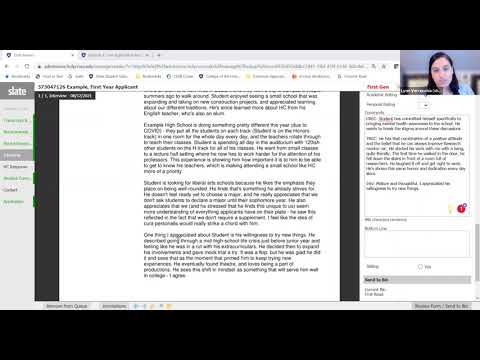
Generally the academic section is first, and then the School Report is the first thing in the academic section. The transcript is next, but the School Report provides the context for the transcript.
Starting with the counselor recommendation is an interesting twist, but it feels to me like the logic is still pretty similar–to put the academic record they are about to consider in context.
This is a good example, and allows people to see what the CRM, Slate, looks like.
But, there are many, many apps where the school report consists of two pages with some very basic information (say proportion of each race at a HS), followed by a lot of ‘prefer not to respond’ notations from the counselor. Some schools have good school profiles, some have bad school profiles, some have no school profiles at all. Notably, many colleges will read apps without any school report information at all.
Similarly in the LoR section, many counselors do not write an LoR. They submit the basic common app one page form and state “I will not be submitting an evaluation for this student.” I am sure this AO made no counselor friends when he was talking around the 16 minute mark and said something like ‘it’s the job of the HS counselor to write this letter to provide to us a full picture of the student’. Talk about out of touch. Ugh.
I would also bet that all HC counselors don’t read apps in the order they share in this video. App readers are typically free to read how they want, as long as they are recording the information the school wants. I can’t reiterate enough…the process at HC might not be the same today.
Lastly, note the information on the right hand side of the screen. That is where readers record what the school wants them too. Each school designs that area and those inputs in the manner they want.
4 Likes
Two datapoints- I took advantage of this service with one of my kids. And the message from an experienced adcom (not a 25 year old kid- this was a grizzled veteran) was “Don’t apply to Brown. We are not a good fit for what you are looking for”.
Second datapoint was a close college friend whose kid was told “Apply of course if you want what we offer. But your chances are about the same as any other applicant.” Only “hook” was legacy, and kid was denied, ended up at Northwestern (so not a slouch academically but perhaps borderline at Brown given the pool that year?)
So the “aside” shouldn’t be that the counseling was a glide path to admissions. At the time it was thought to be a nice amenity for the alumni community when we were all sick of umbrellas and tote bags. I know many classmates who are harboring various degrees of anger/surprise that their kids were not admitted- I don’t know how many of them took advantage of the counseling, but we have all concluded that legacy is not that meaningful anymore- and probably hasn’t been for a while unless you are a US Senator or have recently won a Grammy (thereby qualifying you for EGOT status next year once your movie is released).
Carry on.
52% with any grants or scholarships, but only 15% with Pell grant. Brown seems to give financial aid even at incomes >$200k or so, so it is not like every student on financial aid is “poor”.
He didnt say only poor.
Im not sure how you spend 4 years at Brown and not have engaged in any activity with low or middle income students.
Based on this logic, your family income and upbringing should disqualify you from being an AO?
How much does an entry level admissions officer make? $40-50k? It’s not exactly a lucrative job.
I assume the graduates who want this job share the school’s value system and it’s education mission. I think most people would put Brown in the “progressive” category. Im not sure what the line of reasoning is. These wealthy kids wont admit low income students?
1 Like

It’s 48% of the full time first year students students received aid, according to their most recent CDS CDS. That means that 52% of the students attending Brown come from families that can afford to pay $97K a year. I would find it difficult to believe that even a family making $335K (the lower boundary for the top 5%), unless they also had a substantial amount of generational wealth put aside, or have been on that percentile since the kid was born, and the family could afford saving $20K a year for each kid for college. So the percent of kids from the top 5% has actually increase sine the Chetty article that made such waves.
Here is the thing. For you to claim that they actually DID have the level of interaction that would allow them to understand how highschool is for the bottom 80%, you need to provide proof. I’ve looked at their LinkedIn, and at their interviews, and there is no evidence that they have done so.
To assume that they did have that sort of interaction, a person would actually have to invent an entire story in their head about how they would meet, how they would get to know each other, etc.
Assuming that they actually DID manage to gain that experience as students at Brown, even though they did not engage in any official activity related to that requires a long list of assumptions and suppositions.
No, but because their life experience kept them in a bubble of people from that demographic, which resulted in their lack of experience in dealing with, or even exposure to, how high school works outside of their very limited top 10% experience.
They are the sort of AOs that you would expect if the college was focusing exclusive on their particular demographic.
The more recent Chetty article has demonstrated that the wealthiest kids are accepted at a far higher rate that would be predicted by their academics. So I don’t think that Brown’s admissions office is this bastion of equity and diversity that you seem to believe it is.
My point, though, is that these kids do not know how to look at the application of kids who in the bottom 80% and be able to judge.
Will they penalize applications from lower income kids because their applications are not to the standards set by those of the top students from wealthy families? Maybe, maybe not. They may, instead, not be understand enough to identify the kids from the bottom 80% who are most likely to succeed. All the good will in the world won’t help you is you don’t know how to do your job well.
2 Likes
As a parent, I received a letter from Brown admissions when my kid applied basically saying, we’re glad your kid applied but you should know that legacy doesn’t really mean anything and don’t expect an admissions. (Kid applied RD. Maybe a different letter for ED?).
2 Likes
Their LinkedIn profile or interviews doesnt prove they didnt have interaction with low and middle class students.
These are 19-21 year olds kids only a few years away from HS. I have a sophmore in college and they know a lot about their classmates’ background.
They know where their friends and acquainances went to HS, if they had bad teachers and are therefore struggling in calculus or physics, or chemistry. Why their HS counselor didnt tell them about free resources on the SAT/ACT. Who can afford to fly home over the holidays, cant use DoorDash, or go away for Spring Break.
Last year there was campus uproar at Rice University because they switched their meal plan and kids could no longer donate their meal swipes to their undersourced friends living off campus. You’re assuming something with no basis. LinkedIn doesnt tell you anything about their college experience.
This thread was intended to help students and parents understand Brown admissions - not speculating about the AOs’ interactions with their cohort which none of us know anything about.
2 Likes
There are plenty of kids of privilege at Brown who understand what low income kids go through. However, these are all active in social justice activities, at least at a moderate level. They all have a fairly clear electronic trail of their activities.
My kid has been passionate about LGBTQ issues and, in college, also engaged in environmental justice. Googling her name will bring up dozens of hits about her LGBTQ activism, and a smaller number about her Climate Justice activism.
Googling the names of these AOs brings up a number of things. All of them positive, but not a single one is related to any sort of activity that was about helping low income kids navigate college or admissions, or about engaging lower income youth in any way. In this case, lack of evidence IS evidence.
As long as you’re using anecdotes, my kid attended a college with the same proportion of wealthy kids as Brown. She has interacted with a number, and has had some friends from that SES. She is consistently surprised about how little they know about public high schools that serve kids who are not wealthy. This is after they have spent a good amount of time, socially, with kids who grew up in the bottom 80%.
So even interactions with lower income kids does not provide that much insight, unless a person seeks this out, and few people seek to do so. I mean, why should they? That is not the topic for a casual conversation. Especially a kid who is the only kid in the friend group who is not from wealth.
Poor kids don’t like talking about their experience as poor kids, especially with kids who are wealthier. Middle class kids don’t like talking with wealthy kids about their families’ issues with money either. You assume that the one poor, or even middle class, kid in the group is going to talk about their GC who was overwhelmed while the groups hangs out?
I am also sort of confused about how you even know what you college kid knows about their low income friends. Do you ask your kid when they’re at home from Christmas break “say, how are you doing? What are your friends like? What was the Counselor/student ratio at your friends’ high schools?”
How is Rice University relevant at all to these specific graduates of Brown University? Did Mr. Berman, or any other Brown students, have anything to do with this?
I’m sorry, but you are still engaging an argument that is based based on scenarios that your have written in your mind, and are trying to support your scenarios by somehow showing that wealthy kids somewhere else showed compassion for their lower income peers.
Yes. My D24 tells us about her friends and why they cant afford DoorDash, what courses were offered at their HS and why they have to play catch up because premed is really hard, how their HS counselors didnt give them good advice about their SATs. They talk about off campus housing and their respective budgets, and what their parents can afford. Some cant afford to go on vacation for Sping Break so they’ll stay on campus. They are together all the time and of course these topics come up.
I’m done with this thread. Candidly, if you wanted to talk about the Brown AOs themselves and derail my thread, it wouldve been better if you started your own instead of using mine for social commentary about admissions inequality.
I also think it’s odd you’re Googling 22 year old AOs and looking them up on LinkedIn because you dont personally feel they have enough experience with low income kids but you do you. Id prefer a moderator lock this thread instead of an ongoing debate.
1 Like
Was it only assistance with the student’s Brown application or was it akin to having an educational consultant, who could give some guidance re: the overall application process?
Since you no longer want to discuss this issue with me, I’ll stop.
1 Like
My two kids said similar things during their college years.
I don’t think anyone has mentioned this point yet –
Aren’t the starting salaries for junior admissions officers something like $30,000 or $35,000? Wouldn’t that be likely to preclude someone with student loans? Or not be appealing to someone without a financial safety net? So the system incentivizes hiring those from more financially secure backgrounds.
7 Likes
This is a problem in entry-level-for-college-graduate jobs in many government, other public service, and academic areas. Indeed, it is a problem for entry-level jobs for law school graduates as well, and in other fields. The relevant offices can get well-qualified applicants despite what would be ludicrously uncompetitive salaries in for-profit sectors. But as you point out, that means those applicants are disproportionately coming from families of significant wealth, whereas other families often need their college graduates to immediately start monetizing their degrees as much as possible. But then down the road, these positions can sometimes be gateways into positions of significant influence, power, and so on.
This is one of those things where it is easy to observe the problem, much harder to figure out a solution. Institutions can try to moderate the effects with training and such. But when such offices are fighting for budget in every corner, it is tough for them to justify paying a lot more for entry-level positions than they strictly need.
4 Likes
@MWolf you make a good point that it is important for the admissions process to include meaningful effort and opportunity for AOs to understand the context of each application, including those from students with varying levels of privilege. That’s definitely valid. But you seem awfully negative on these two AOs based on assumptions you are making, not only about their background and privilege (you’re probably right, at least to a degree, but you really don’t know them well just from reviewing their linked in) but also about the overall admissions process at Brown. The BDH article is interesting but it’s super high level and doesn’t necessarily cover all the steps and consideration that is given. There may be (likely are) other more senior reviewers that are specifically engaged when a student comes from a particular background, or supports a particular institutional priority. This was definitely true when I attended Brown in the 1980s. They had an AO fly to my house to encourage me to attend (after I was admitted) who told me a little bit about the process back then. I don’t know if they still do that, but I do think you are making a lot of (negative) assumptions about the value these young AOs can provide. I’m not saying that to attack you and saying it as much as possible without intentional shade…just observing. A new AO from a privileged background can still provide thoughtful insight. I hope the Admissions process at Brown (and other schools) provides a more comprhensive review than just a single, young privileged AO…and I suspect it does.
2 Likes
In fact, my rough understanding of what more experienced regional supervisors are supposed to be doing includes having a better understanding of the different contexts kids are coming out of within their region. And that in practice can take the form of being a little less exuberant about kids with lots of advantages, and more open-minded about kids without a lot of advantages, than a less experience reviewer might be.