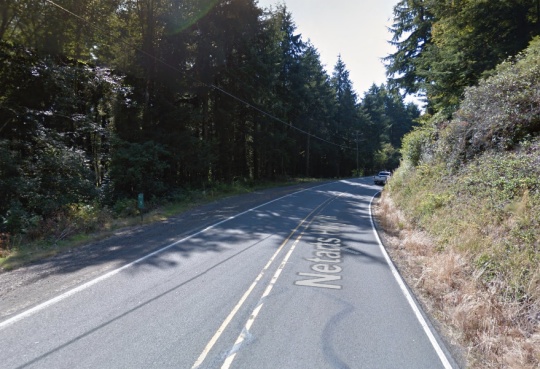
<p>I don’t see any indication that he even saw him.
Blind corners, two lane rural highway, 74 yr old driver, no paved shoulder, he probably didn’t see him in time to stop.</p>
<p>if those I share the road with, truckers, motorcycles, and bicyclists, why is it that cyclists are the only ones who don’t have to be liscensed and insured?
Why do bicyclists advocate AGAINST requiring liscensing?</p>
<p>I am always very careful around cyclists who race down my road in packs on the weekends. </p>
<p>But the cyclists don’t seem to think that stop signs were meant for them. They’d rather keep the momentum of the downhill going than stop. A woman pedestrian was killed by a racing bicyclist in New York last week. Yes, most of the time it’s the other way around, not necessarily because the car was the one in the wrong but simply the laws of physical impact. </p>
<p>I’m sure the driver “didn’t see” the cyclist. But if a driver didn’t see a lawful cyclist riding where lawful cyclists ride (the cyclist was a cycling safety instructor) then the driver was driving dangerously. If you watch the gorilla video and look for gorillas, you will see the gorilla. If you know that gorillas are in videos, and you must see them, then you’d better pay attention and look out for gorillas. Not seeing a gorilla when you are supposed to be looking out for gorillas, and the gorilla is clearly visible, is not the gorilla’s fault.</p>
<p>The driver rear-ended the cyclist. Not being able to “see” what is directly in front of you is your fault. You’re expected to pay attention.</p>
<p>I’m sick and tired of drivers who aren’t paying attention killing cyclists. Somehow in other countries, drivers manage not to kill cyclists. It’s not a physical limitation of sight that prevents American drivers from killing cyclists by rear-ending them; it’s inattentive drivers who don’t care if they kill people.</p>
<p>Again, this was a cycling safety instructor, riding along a road lawfully, rear-ended and killed by a lethally negligent driver. Other cyclists who run stop signs have no relevance to this death.</p>
<p>Most streets don’t have bike lanes in our city. So for me, its hard to judge 3 feet when I’m driving and someone is to the right of me. What really bothers me are the cyclists that don’t adhere to the pedestrians in crosswalks. Or those that blow past red lights when I have the green light. I guess the rules only apply to the motorists?</p>
<p>It’s a matter of how much damage the road user can do. Drivers of motor vehicles can do a lot of expensive and lethal damage, so they need to be licensed and insured for the safety of other road users.</p>
<p>Those of you who say cyclists “yell at you”–are they, perchance, yelling “on your left” or “on your right”? Those are courtesy announcements that indicate that they will be passing you–it doesn’t mean they expect you to get out of the way; it mean they don’t want to scare you.</p>
<p>I spent ten days in July riding my bike down the Oregon Coast, much of the time on Highway 101, speed limit 55, bikes in shoulder all along the road (it’s an Oregon Scenic Bike Route). Visibility is good. My husband and I wore day-glo colors, had lights on our bikes (red flashers to the rear, white flashers to the front when appropriate). It was sunny and clear for 8 of the 9 days.</p>
<p>Most drivers were careful and appropriate. Even the drivers of the logging trucks were fine. It was the huge RVs that scared the **** out of us from time to time. Their rear-view mirrors added feet to their width and were right at head level–and the drivers seemed to be utterly unaware of how wide their RVs are. RVs require no additional licensing, unlike trucks. (RVs also push a massive amount of air in front of them, causing buffeting to cyclists. Trucks are more streamlined.)</p>
<p>I ride all over Portland on my bike. The most dangerous drivers are the ones turning left–who don’t realize there’s a bicycle in the lane on the other side of the car that just cleared the intersection–and the ones turning right–who accelerate, pass me, then try to turn right in front of me. Just wait ten seconds, folks, you can turn right behind me far more safely.</p>
<p>I always stop at red lights. I usually do not stop–but I do slow way down–at stop signs WHEN I CAN SEE THE APPROACHING TRAFFIC AND THERE ISN’T ANY. Stopping–as in putting a foot down–is unnecessary in many situations. If there is approaching traffic? Yes, I stop.</p>
<p>The roads are dangerous places. I just returned from running an errand. I was in the center lane of a street with three lanes in each direction. There was an SUV in the lane to the left of me, about half a car length further. We had both just turned left onto this street, so I guess we were probably going about 35 mph. All of a sudden the SUV’s break lights went on, then immediately two bodies ran right in front of me. I probably missed them by 2 feet. The SUV had blocked my view of these two idiot teen girls just running right out into a busy street nowhere near a crosswalk. They were laughing hard at themselves. All I could think to myself was “STUPID! STUPID! STUPID!” I would probably have killed them if I’d hit them, and even though not remotely my fault, I would have been scarred for life knowing I was involved in such a tragedy.</p>
<p>“Seeing the gorilla” applies to one kind of guy in a suit. As I tried to explain, human powered wheeled conveyances on the road have gotten more and more variable in my area. I am looking for regular bikes but can still be taken aback by the racing unicycle and the hand crank thing that’s about 12 inches off the ground. </p>
<p>On making eye contact if you are walking or riding across a driveway and a car is waiting to pull out if you try to make eye contact and they don’t seem to see you then assume that they don’t and act accordingly. How is that hard to understand? If they act like they don’t see you then you are welcome to be right and take your chances but when I am advising my kids I advise against it.</p>
<p>I looked at that picture of the road, and it looks exactly like many many roads that cyclists ride on. I have ridden hundreds of thousands of miles on roads just like that. It is possible for drivers to drive safely on such roads. This was on or near the Pacific Coast Route, an area popular with cyclists, so it should not have been a shock that a cyclist was riding on that road, and the driver had a duty to be careful. He was not, and now someone is dead. I hope he goes to prison. I’m tired of cyclist killers getting a slap on the wrist and a sternly worded letter. Maybe if more cyclist killers see the inside of prison cells, American drivers will start being more careful.</p>
<p>I drive a lot on the Boston Post Rd. It’s very old and much too narrow for the two lanes of traffic and one of parking spaces in each direction. I often share the road with people on bicycles. The only place for the cyclists to ride is in the right-hand lane. If I am behind a cyclist, I stay well behind him and slow down, until I can go into the left-hand lane and pass him safely. Of course, drivers behind me often honk because I am driving “too” slowly. I always feel bad for the cyclists and wish they had a safe place to ride.</p>
<p>I certainly don’t mind slowing down for a few minutes until I can pass. But what always happens is this: I have to go through the slowing down/passing thing several times on a drive of a couple of miles, because the cyclists go right through red lights. They will come from behind when the cars are stopped at a red light, go through the narrow spaces between cars in the rh lane and the parked cars, or even between cars in the rh lane and lh lane (where no one expects them to be), and go through the light. So I end up having to pass the same person several times.</p>
<p>I always pass with a lot of space, more than 3 feet, because I worry about the cyclist hitting a stone or something and swerving. I hate how vulnerable cyclists look and I am as careful as I can be.</p>
<p>The person on the bike may be three feet wide.</p>
<p>I find it odd that bicycles are prohibited on interstate highways, which usually multiple lanes and paved shoulders, but they are permitted on rural roads with speed limits of 55, only two lanes, and no shoulders at all.</p>
<p>Not a fan of bikes on busy city streets at rush hour. They often block cars from making ROR and other traffic efficient moves. Seattle is hilly and they can block a lane puffing uphill and our streets already are inadequate and often in poor condition. During rush they should be limited to a few designated routes and off-road bike lanes.</p>
<p>Of course counting handlebars! You see a cyclist in front of you. They’re about three feet wide, ballpark. A little less, actually, so imagine a little bit of space around them. That’s how much room you have to allow between the edge of their bike and the edge of your mirror.</p>
<p>Bikes are not prohibited on all interstate highways. They’re allowed on many interstate highways in the west. I have ridden on interstates. Adventure Cycling routes cyclists on I-5 at the border between California and Oregon, basically because there isn’t any other road to use. I’ve ridden that section in both directions. </p>
<p>The problem with bikes on interstate highways is the exits; it’s dangerous to cross an exit ramp on a bike when there are cars exiting at high speed, as they would be on freeways. The part between exits isn’t dangerous, although on busy interstates it’s not particularly pleasant. </p>
<p>Rural roads don’t have high speed exit ramps, so they don’t have the problem of crossing exit ramps.</p>
<p>Cyclists where I live seem to ride on the white line dividing the car lane from the bike lane. This means that one still must wait until there is no oncoming traffic to pass.</p>