Great site! Can someone help me understand the math here and how this works- states that had HUGE explosions in cases, like Massachusetts, show a steady R of ~. 8 throughout. Shouldn’t it have been higher in the beginning (March) and lower now? Or is it because the R factor was just wrong in the beginning because of silent spread/ no testing?
Do you really think this is a public education thing? I agree that quarantine facilities will help reduce spread, but so you really think Americans, who in many cases don’t even want to wear masks indoors, would agree to stay in a facility for weeks instead of home? Could they leave (even sick) if they wanted to? The cruise ship passengers were not allowed to leave their quantine facilities until testing negative. Why would these be different than those quantine facilities? I just don’t see this being feasible, especially since it costs money to run and states don’t have any right now.
In NY, I did see alot of hospital workers staying in hotels so they didn’t expose their families.
Colleges are looking to do this type of thing using designated dorms and/hotels to quantine sick students. Along with testing, It will certainly help stop the spread if there is an outbreak.
https://www.local10.com/news/local/2020/06/11/coronavirus-florida-reports-record-1698-new-cases-in-one-day/ Have the Fla numbers continued to climb since this wa reported? Didn’t FL stop reporting numbers at one point?
And the three necessary components to open in-person are going to mean more buses, more staff, and more cleaning. All will cost more money. And how much influence will the teacher unions really have? In some states a LOT of power, but in others not much (right to work states).
For staffing needs, I think there will need to be a redeployment of forces, and I wouldn’t start with art and PE teachers.
Essentially, there would need to be more of a defined separation between instructional time, which would happen with the classroom teacher, and independent work time, which could be staffed by anyone, namely secretaries and administrative staff. The gaps could be filled by subs, who are paid an hourly rate far less than the cost of hiring more teachers. For extra room in order to divide students into smaller classes: classes in auditoriums, the gym, the cafeteria; all of these are usually large spaces that could be sub-divided with temporary barriers at relatively low cost.
There would also, ideally, be mechanisms to allow for quick, temporary shifts to Zoom, as classes in which a student tested positive would have to be told to stay home for two weeks.
But in any case, there are best practices, and reality. The cost of keeping low-income students, in particular, out of school for a significant length of time is too high to wait around for best practices.
Yes, they’ve continued to climb and will probably continue to climb more in the future. Combination of reasons - from more testing to influx of tourists to reduction in distancing. And, like other large states, the spread is happening unevenly. Infections are increasing rapidly in the Miami area followed by Tampa and Orlando, but there are still large parts of the state with few infections, so response on a targeted basis rather than state wide might make more sense.
I do think mask wearing and possibly even willingness to use isolation housing is a public education issue. People have lost trust in media and political they perceive as biased with an agenda. Public education that includes trusted figures on all sides of the political, social and economic spectrum along with expert testimonial would help, even if it wouldn’t solve everything.
Until there’s a blockbuster cure or virus, there’s no one solution. Keeping infection levels low will be a result of a combination of dozens of smaller efforts that collectively result in making a difference. The measures and initiatives will even vary depending on the state, city and local populations.
I’m in the same state as @suteiki77 . So far, the state has issued some guidelines that do include social distancing (which will likely mean reduced numbers if students in classes), and that it is suggested that students remain in the same class with the same cohort while they are in school.
This is way easier at the elementary level where most students in this state are in the same instructional classroom all day long. It’s not so easy at the secondary level where students mix and match for classes due to instructional needs.
The districts I know of are working on multiple plans. These include hybrid online/in person instruction, all online, all in person, and the like. The districts will be required to submit a plan. Everyone will need a plan to return it all distance learning if that becomes a need.
I can see the PE teacher doing health lessons in the elementary classrooms, and some things like isometrics, and any kind of “movement or exercise” one can do in their own personal space. Elementary level.
Our music teachers are very creative, and have tons of instruments, recorded music, music videos of performances, etc. These could easily be used in a classroom.
Our art teachers at the elementary level were going to be on a cart anyway next year. They absolutely can do a lot of what the do in a classroom.
Or small town has a large number of day care centers for such a teeny town. Still…any staggered schedule for the little ones is going to create a day care nightmare for working parents, and I think a lot of districts are trying to minimize this as well (knowing that these daycares will be operating at reduced capacity as well).
It’s going to be complicated. But I do think the stakeholders (and that needs to include the parents) will make the best decisions they can make under the circumstances.
Oh…transportation. There was a pictures the governors guidelines showing a school bus. Only one student per row, and alternating sides so that if a student was on the right side Of the bus, the next row student would be on the left side of the bus. This would create a row between each kid as well. PLUS districts would be required to hire a bus monitor for each bus to help kids remember to stay put, and wear masks. I think there could be maybe 15 kids on each bus max. Many of our buses hold WAYYY more than that usually. And parents are being encouraged to transport their own kids as well. Our parking lot is already a mess with the smaller number of student drop offs. This could be challenging as well.
Here’s a BBC article regarding the mental health impact of isolation and no school for kids. 100 specialists in mental health sent a letter to UK’s Education Secretary warning of the effects of isolation in young people, which also references a Lancet opinion piece, which warned of ‘the damaging long-term consequences of a lack of face-to-face contact among young people and their peers’.
Article has a UK focus but also says that suicide is the leading cause of death in 5-19 year olds in the UK, and the second leading cause of death globally. They did not say whether that was the case pre-covid19, although I know many areas in the US and across the world are seeing a rise in suicides and suicide attempts since the pandemic began.
Tens of thousands of children remained in school throughout the spring in places like the UK and Denmark, where schools stayed open for children of essential workers and children deemed vulnerable ( special needs, foster care, etc). Why aren’t we using that experience as a guide?
For US reference pre-Covid, here are the leading causes of death by age:
https://www.cdc.gov/injury/images/lc-charts/leading_causes_of_death_by_age_group_2018_1100w850h.jpg
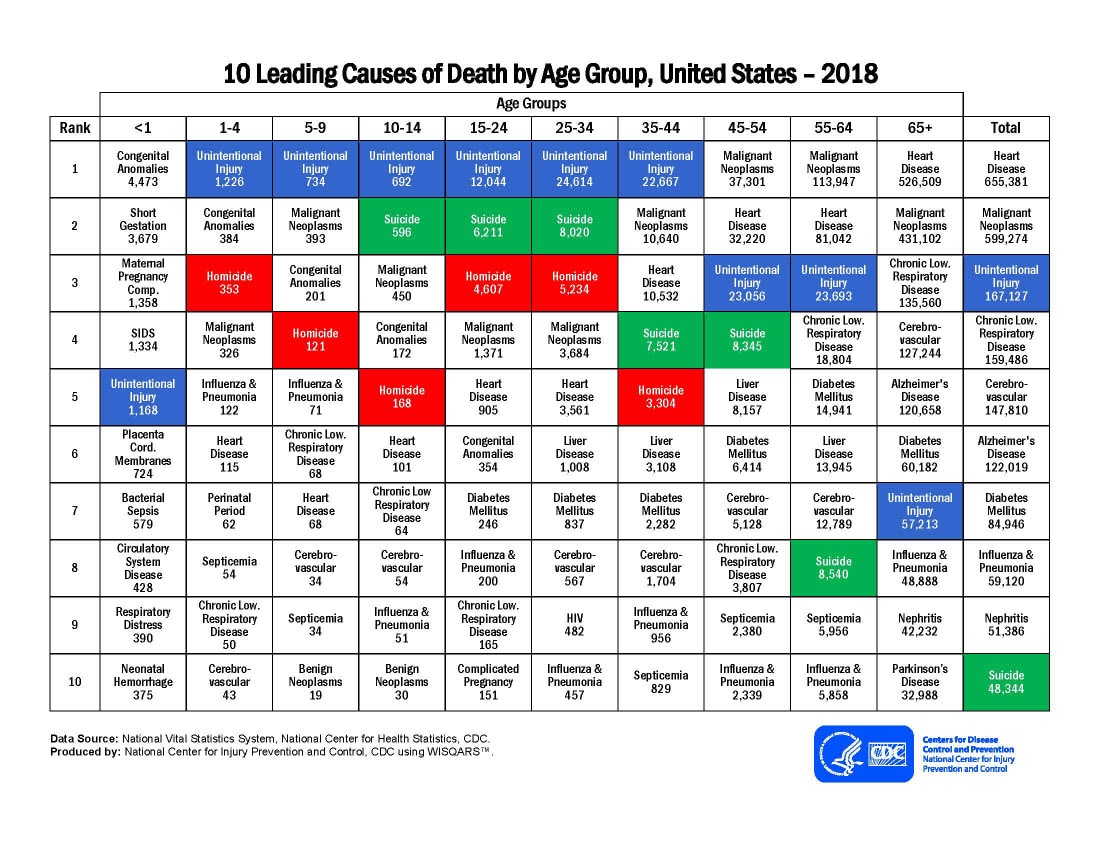
Suicide is highlighted in green and is the second leading cause for ages 10-34. Accidents are first.
If suicide has moved to #1 (no idea for US), one also would have to balance out the actual numbers considering accidents have probably decreased with folks not traveling as much. Moving to the top because #1 moved down doesn’t mean there are more happening.
It would be interesting to know how things are shifting, but I’m not sure we’ll see that data for another year. If anyone does, please post it.
As an aside, it’s amazing how quickly cancer and heart disease move to the top as people age.
In NY state there is subsidy for childcare and there are regional enrichment centers for essential workers children.
https://www.schools.nyc.gov/enrollment/enrollment-help/regional-enrichment-centers
We have child care here for essential workers. But as time goes on, more and more parents will be expected to return to their workplaces. Even if they WFH, there is the potential to have their kids doing distance learning for part of the day. Plus…transportation in the middle of the day for parents who don’t want their kids riding the school buses.
I don’t envy school districts making these plans. It will be challenging.
MODERATOR’S NOTE: As was said many, many pages ago, the subject of what New York did wrong has been beaten into the ground quite thoroughly. Please move on.
I am wondering when visitors might be allowed again in assisted living facilities (and other facilities). Outside, with masks, would seem to be relatively safe.
In China they forcibly removed people from their homes. That’s going to be a no-go here and thus the facilities set up here have been underused as @milee30 points out.
The day camps here are opening for shortened sessions at the end of June. It actually seems safer than schools opening where staff and bus drivers are often older and in more vulnerable groups. Our day camps are staffed by teens and very young adults, including the bus drivers. It is a physically demanding job and tends to attract more fit workers. The “ older” administrators are all 25 and under at the camp my kids used to go to.
There are still issues of course but better than different circumstances.
I live in Wisconsin, the population of which is about 25% of Florida’s. The number of new cases announced yesterday in Wisconsin was about 10% of Florida’s. I don’t offer these numbers to brag or to drag down Florida. I’m confused and alarmed. I’m glad my state’s numbers are going down but I don’t feel good about other states’ (and countries’) numbers going up. I truly think that we (the human race) are all in this together.
This morning, I feel as low psychologically as I have at almost any other time during the pandemic.
Beijing reimposes lockdown measures after a new outbreak of 57 new cases. The city had previously gone 55 days without new cases:
https://www.theguardian.com/world/2020/jun/13/beijing-china-new-covid-19-cases-linked-to-food-market
This is going to continue until there are treatments or vaccines. The only posts that give me any hope are about progress on those, though I try to be realistic there too.
It’s been three months. I don’t even think this is the first inning.
I
@compmom in CT, there have been some guidelines for visits to skilled care places. Outdoor only, and by scheduled appointment time so that the outdoor spaces aren’t crowded and there is sufficient staff to help move residents.
Our weather here is terrific for these outdoor visits now.
Not sure what places with blazing outdoor temps will do.