<p>In my fifty plus years on this planet, I’ve yet to meet anyone who has brought up the Civil War as some sort of unresolved issue they feel like grudging about. And if I ever do, I’ll get away as fast as I can…nothing says “whack job” better than getting all hot and bothered about the Civil War. Let’s get back to decoding preppy, please! </p>
<p>Good idea. At this point, are we decoding preppy as a state of being or as a fashion statement?</p>
<p>
</p>
<p>Isn’t it considered both? :D</p>
<p>The way I read the OP post, it sounded like preppy was a vibe at certain schools. Not like she was trying to identify schools with actual WASPy true preps. </p>
<p>I think there are definitely schools where many people would say off hand that they are preppy. Colgate, wWake forest, Hamilton come to mind. Then there are schools that you would not define as preppy: Sarah Lawrence, Penn State, CMU for example. </p>
<p>I’m torn, actually, preppy is in its pure form is an unattainable state of being that requires generations of preparation. I only find it only appealing in the male form…something about a disheveled, hungover Yalie wearing his grandpa’s old overcoat…but I digress. </p>
<p>"The areas where what I described was prevalent were mainly rural areas of Mississippi which are where most of my southern relatives are based. There seemed to be a large contingent of “lost cause” piners among their neighbors. While they weren’t the majority, they were extremely vocal and had critical mass numbers.</p>
<p>I’ve also observed some of this with a few neighbors in visits to relatives in rural parts of Northern Florida and friends in rural parts of Northern Virginia. However, in those areas, they were in a distinct minority and widely dismissed as silly cranks by most of the neighborhood in those areas."</p>
<p>Cobrat, how would you know what the “majority of the neighborhood” thinks in areas where you are just visiting friends / relatives? Do you canvass the neighbors? How many “neighbors” of your relatives do you meet, anyway? Is that normal social behavior, to visit your relatives and get to know the majority of their neighbors in any depth other than perhaps a “how do you do” and a nod? </p>
<p>
</p>
<p>I think it’s both. </p>
<p>The look is easy to identify–I think the perfect reference point would be to look the fashions of those who “summer” on Nantucket: Nantucket reds, bow ties, khakis, Topsiders, Lily Pulitzer dresses, lightship basket purses–for the uninitiated: <a href=“http://jeannettedouglas.ca/wp-content/uploads/2013/07/DSC009761.jpg”>http://jeannettedouglas.ca/wp-content/uploads/2013/07/DSC009761.jpg</a>. </p>


<p>These shorts also capture the look:
<a href=“http://therealcape.com/wp-content/uploads/2014/02/reds.jpg”>http://therealcape.com/wp-content/uploads/2014/02/reds.jpg</a></p>
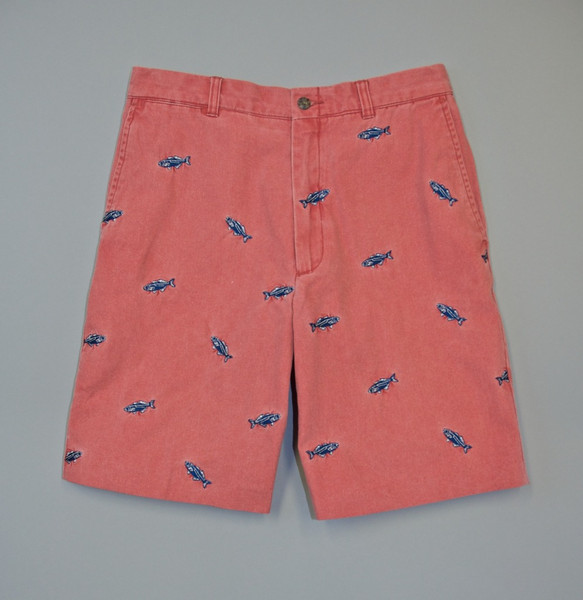

<p>As for the preppy mindset–that’s harder to capture. I’m not sure it’s as easy as identifying the clothing. Much of has to do with something over which we have no control–your family pedigree.</p>
<p>The preppy mindset certainly isn’t about “did I get 2400 on my SAT’s”? There’s an effortlessness about prep, tha that things come naturally, easily and they all work out. There’s a word for this, and it’s not coming to mind right now. Nonchalance - but that’s not quite it.</p>
<p>Serendipity?</p>
<p>I don’t think OP’s question has much to do with analyzing what the <em>essence</em> of “preppy” is. He’s asking what do people mean when they say a college is preppy? They mean a lot of the kids wear clothes like those sold by Vineyard Vines. Period.</p>
<p>
</p>
<p>Trust fund?</p>
<p>^Haha, nice @mokusatsu. Most I know and have seen have a very laid-back, devil-don’t-care, confident attitude…an attitude that probably is made possible by their trust fund. I guess they kind of act the way they dress: Relaxed but put together. They are socially very “chill” (kind of a hippy-ish description, but can’t find the right words here) they get along with most everyone and really seem to not care what others think of them. Someone said “effortless,” I think that’s a really good one. They care (or most do) but they only let you see the results of any hard work so that everything appears effortless. </p>
<p>That said, the above attempt at a description (it’s really hard to pinpoint) only applies to those who can truly afford the lifestyles they live (ahem…trust funds). Most of my non-trust-fund-kid friends who are trying to fit into more affluent societies by dressing southern prep/country clubish are much more insecure and everything else that true preps aren’t. I can tell right away whether someone I’m talking to is truly wealthy enough to afford the prep lifestyle, or just dressing the part. There’s just something about the way they act and talk…I just can’t find the exact words. </p>
<p>I think @southerncharm95 has hit on something that is an inherent and hard-to-copy feature of the preppy look—a relaxed confidence and feeling that “I belong here” that comes through even if the Brooks Brother shirt is frayed around the collar. </p>
<p>^@EllieMom yes, the “I belong here” feeling is a good one. </p>
<p>To the OP, if you’re worried about a bunch of rich preps at potential schools, keep in mind that the majority of the preps you see are probably just college kids who break the bank to be able to afford the clothes on their backs. That’s the way it is for many of my non-wealthy friends. They either have parents that work hard to buy them the clothes, or they work at Vineyard Vines or Lilly Pulitzer so they can get free clothes and huge discounts. I have these four friends- one who works at VV, one who works at LP, one works at Southern Tide, and one who works at J.Crew - Between the their discounts and free gifts, they have a trading ring of sorts going so that they can all afford to stock their closets with “The Clothes.” They can’t buy the true prep’s attitude though…I don’t think those come with a discount because they seem to require old money and true wealth. Anyways, because of their insecurities, they’re really quite easy to become friends with and shouldn’t be a problem for your daughter.</p>
<p>A scene from Fawlty Towers:</p>
<p>Referring to “Lord Melbury”, a guest who has just checked in.</p>
<p>Basil: He was quite charming… Oh it’s delightful to have people like that staying here. Sheer class. Golf, baths, engagements…
Sybil: Well I’ve never seen such tatty cases.
Basil: Of course you haven’t. It’s only the true upper class that would have tat like that… It’s the whole point! …Oh, you don’t know what I’m talking about.</p>
<p>*Not long ago, expensive materials could be identified on sight, and fashionable men and
women recognized Savile Row tailoring or a Paris designer dress at a glance. In the twentieth
century, however, synthetics began to counterfeit wool, silk, linen, leather, far, gold and precious
atones more and more successfully. At the same time, manufacturing processes became more
efficient, so that a new and fashionable style could be copied in a few months and sold at a
fraction of its original price. Moreover, the economic ability to consume conspicuously had been
extended to millions of people who were ignorant of the subtleties of dress, who could not tell
wool from Orlon or Schiaparelli from Sears Roebuck. As a result there was a world crisis in
Conspicuous Consumption. For a while it seemed as if it might actually become impossible for
most of us to distinguish the very rich from the moderately rich or the merely well-off by looking
at what they were wearing.</p>
<p>This awful possibility was averted by a bold and ingenious move. It was realized that a
high high-status garment need not be recognizably of better quality or more difficult to produce
than other garments; it need only be recognizably more expensive. What was necessary was
somehow to incorporate the price of each garment into the design.
This was accomplished very simply: by moving the maker’s name from its former modest
inward retirement to a place of outward prominence. Ordinary shoes, shirts, dresses, pants and
scarves were clearly and indelibly marked with the names, monograms or insignia of their
manufacturers. The names or trademarks were then exhaustively publicized – a sort of saturation
bombing technique was used – so that they mght become household words and serve as an
instant guide to the price of the clothes they adorned. These prices were very high, not because
the clothes were made or superior materials or constructed more carefully, but because
advertising budgets were so immense.*</p>
<p>I can’t figure out how to link to the pdf. Fashion and Style by Alison Lurie. She also wrote The Language of Clothes where I believe she decodes the preppy look. </p>
<p>I haven’t read the whole thread, but I agree with other posters who say that you should visit in order to see what the place is like. Dress is certainly an indication of whether someone fits in, or would want to fit in, or whether many styles of dress are present. In some colleges, all black clothing would be considered weird, and at others just fine. Some might have seersucker preppy as well as all black wearing students. If I was a wearer of ripped jeans, all black clothing, gauze fabric shirts/skirts, and everyone else wore polo shirts, salmon shorts and topsiders, I would consider how comfortable I felt there. </p>
<p>As to whether the “preppy” kids have money, this IMHO, is less and less true today. People dress like the group they would like to be a part of, but this does not do more than create an image. You can buy polo or sperry or vineyard vines on line from anywhere. Also, fashion being what it is, always has knockoffs that are cheaper but give a similar look.</p>
<p>“Preppy” clothes are by no means limited to those with money. Even some public grade school uniforms in low income areas are polo shirts and khakis. </p>
<p>Some may not realize that there are some kids who own none -zero-zilch of those types of clothes. No collared shirts or pants other than jeans and sweats at all. Those are the kids who will probably find “preppy” campuses more foreign, and should consider that in advance. </p>
<p>But when kids say they’re turned off by a campus’ preppy vibe, my guess is that it has more to do with the attitude than the fashion statement. My daughter is perfectly fine with aspects of the look (loves her classic Sperrys and vintage Lilly Pullitzer), but the preppy attitude isn’t her cup of tea. She’s much too “nerdy” to pull that off. </p>
<p>There are plenty of nerdy kids who went to prep school and who wear preppy clothing, so she must mean something more specific to herself when she talks about preppy. Maybe she means it is too social for her. </p>