<p>I like to know collges that have a good pre-med program in Eastcoast.
Is there any infor regarding the medical school matriculation from each pre-med program?
Some colleges have pre-med program as a major and some colleges do not have pre-med
as a major but help students help prepare for medical school. </p>
<p>I like to know the colleges that have pre-med as a department(major) and their medical school matriculation data.</p>
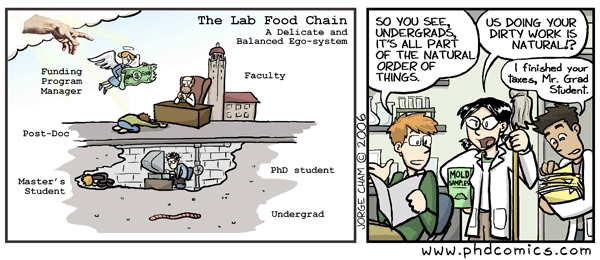
<p>…But honestly, what decent university doesn’t have good research going on? You’re not really going to know what is going on research wise ‘til you get there. In my experience, I’ve actually found smaller schools to have better research programs for UG students than larger ones. Remember, as a UG at a large institution, you’re lower than than crap on the food chain. On a good day, you might get eaten by the detritivores, if you get my drift… Smaller programs often still have extremely well-known and recognized faculty who have chosen to go to smaller programs and now run smaller (yet still highly productive) labs that actually use UGs as more than specialized janitors and data input monkeys. These labs, I believe, are the hidden jewels. They’re the ones you want to find. If you go to UCLA or UCB or Harvard, you’ll be nothing but a lab bench cleaner or, after a couple years’ experience, a data input monkey. Either way, good luck making that sound impressive to an interviewer…</p>
<p>I feel like saying that all UG lab researchers at big unis are lab monkies is a generalization apumic. I personally can’t comment on it one way or another, but I would recommend that if you go to a large public university that you try to get into a program of distinguishment (such as honors colleges). This will probably increase you chances of getting a respectable research position.</p>
<p>I’ve actually had really good research experiences myself but am aware of others having poor ones. I don’t think all UG RAs are lab monkeys, but as I am doing a PB at a large research U after having gotten my bachelor’s at a smaller (but well-respected) research u, one of the major differences I have noticed is in the quality of positions for UGs. Whereas at the smaller school, our UG students were presenting, publishing, running their own projects, etc., I have noticed that where I am now, it is difficult for anyone but PhD students to get those opportunities. (Once again, I have managed to get one of those opportunities myself as a PB, but very few of the UGs there are able to do so and by percentage there are far more “crap labs” here than there were at my UG.) My old research adviser, an alumnus of one of those top research U’s (at the UG, MS, and PhD levels) has told me of similar experiences. While it is definitely a generalization, I state it as such only because so many people here think going to a big research u is their ticket to med school. If you want to do research, go somewhere where you’ll get good opportunities. Go somewhere where you know they use UGs as actual researchers and focus on training you as a researcher, not as a lab monkey. What you really want as a UG is to work with a well-established researcher who is willing to train you and wants to develop you as a researcher. You want a generous PI, not necessarily an extremely well-acclaimed one, when you start out as a researcher.</p>
<p>When you just join a research group as an UG who has had no prior experience before, do you usually receive some form of unofficial “on-the-job” trainings by some more experienced researcher/mentor (who is most likely a post doc or PhD student, rather than the PI himself) in that group? Or, do they expect you to hit the ground and run, that is, to start to do things all by yourself from day one, like how to do something to a lab mouse or to operate a piece of equipment? Is there usually a “transition period” when you are allowed to pick up things that you need to learn before you can contribute? How long is the transition period typically? If you are a newbie, are you usually required to attend a weekly meeting (if there is one in that research group)?</p>
<p>I suspect that the PI and experienced researchers may rarely assign critical jobs to any new group member. This is because they are under a great pressure to get things done and get the paper published as soon as possible.</p>
<p>Most labs will have course prereqs (e.g., research methods in…). That is your formal training and usually success here is a prereq to getting into the lab. From here, as a UG you are likely to be placed as a research asst on a team. You may get some mentoring from a grad student (or the PI) depending upon the quality of the lab. Ideally, you end up in a smaller lab your first time w/ a good PI who is able and willing to train you personally, but this is often not the case. It really varies by lab. I’d say most quality labs require a minimum of 1-2 years commitment as it generally takes about a semester just to train a new RA. Labs vary quite a bit, though, and once you’ve been a part of one (for awhile), the req’ts may slacken a bit. For instance, I was a member of lab for a couple of yrs as a UG and am now continuing loose collaboration from 1000 miles away. I’m still technically part of the lab but I don’t attend weekly meetings. I do the work and email my collaborators.</p>
<p>haha, yeah… I do hang out there a bit more than I should! It’s my way of feeling “productive” without actually getting anything done. It lets me procrastinate other things w/o feeling guilty. lol… like studying for my exam in, oh, let’s see…12 hours and 22 minutes.</p>
<p>I’m riding that one with you my friend. T-minus 8 hours give or take and all I need to do to be finished studying is memorize all of the enzymes/proteins involved in</p>
<p>D. just started at lab. at her state college. It sounds more interesting than being described here. She was given her own research project with very specific goals and procedures with very detailed info (lke how many animals, time in minutes for certain measurements), she was told to write and submit grant proposal for her project with very detailed info about experiments, theory behind them and what she is looking to cover by grant money, which she has completed. It all sounds very interesting, she seems to like it since it is within her interest in neuroscience (one of her minors). She has prior experience while in HS working (paid employee) in Med. lab with the same animals (not cleanning, but participating in procedures, taking measurements…)</p>
![http://www.phdcomics.com/comics/archive/phd041206s.gif[/img]](http://www.phdcomics.com/comics/archive/phd041206s.gif%5B/img%5D)