I agree my post’s wording was a little sloppy, but you get the point.
1 Like
My high stat D24 was one of those waitlisted and denied! I thought she had a shot but oh well!
4 Likes
The short answer to your question is: “probably not”. 1510 is a great score for Rutgers, but you can look at Common Data Set to see where it lands in the SAT range for each of the schools on your kid’s list.
1 Like
This site offers a Selectivity Rank column, which may help you recognize selectivity zones that may be underrepresented in your son’s current list:
For example, the addition of colleges outside the top, say, two dozen by this measure, but within the top 50, may enhance your son’s list. For your son, this might be regarded as a desirable high-match zone.
this. 100% this. It is SO TRUE, even if OPs kid says they would be happy at Rutgers. If that is the ONLY acceptance he has, it really does something to the ego. My son went reach heavy last year with a few targets and 2 safeties. And those reaches are reaches for everyone, yes OP, you may tell yourself differently but when the acceptace rates are in the teens or lower, they are reaches for EVERYONE. Thank GOD my son had more than just one likely/target because when those rejections start rolling in, it’s hard.
8 Likes
I do agree. There were a number of kids I know who only applied to reaches or maybe high target schools and had UIUC engineering as their safety. But they were rejected. Slowly there were rejections and waitlists until finally the UCs started to come through. It takes a blow to your ego and confidence when schools you believe are targets are not targets but actually reaches. Same with another high score kid who applied to mostly UC schools and did not get into the top schools until finally UCSB. That worked out but does play games with your mind.
2 Likes
@cloudymind, how would it impact your son if the responses from the colleges looked like this?
- Deferral (from ED school)
- Acceptance (w/no honors program)
- Rejection
- Rejection
- Rejection
- Rejection
- Rejection
- Rejection
- Rejection
- Rejection
- Waitlist (from the original deferral)
- Rejection
- Rejection
- Rejection
Even if we switch it to look like this with 2 acceptances, what would the mental impact be?
- Deferral (from ED school)
- Acceptance (w/no honors program)
- Rejection
- Rejection
- Rejection
- Rejection
- Rejection
- Rejection
- Rejection
- Rejection
- Acceptance (from the original deferral)
- Rejection
- Rejection
- Rejection
Nobody on this thread knows which colleges will accept your son. Since the vast majority of the schools on your list are reach-for-everyone schools, the odds indicate that he will get a rejection from them. Rejection is an emotional and mental blow, and even if one is still standing strong after the first, second, or third blows, by the time you’re getting to the eighth, ninth, tenth, or more rejection, a lot of one’s internal reserves get used up. Having additional acceptances helps to cushion and blunt those blows.
All I can say is please, please reconsider your position on the college application list.
16 Likes
In terms of the plan to switch to the ACT, which version is he planning to take? The reports on the April enhanced ACT is that the math is significantly more difficult than the “original” ACT.
Yes, weighted GPA is usually meaningless outside of the high school (or if it is weighted specifically for a specific college).
This is spot on. It is really hard to gauge the effect multiple rejections will have. I’ll use my D22 as an example.
For context, D22 just finished her junior year at Barnard (one of the colleges of Columbia University), so one can safely say that she won the admissions lottery. During the application period, she had a very balanced list of ten schools. She did not want to ED anywhere.
She was accepted to her first couple of likely schools in October and a few more in November and December, so she had four good offers in hand by winter break. But here’s the thing: the most selective schools tend to be the ones with the latest decision dates.
The month of March contained two wait lists (from schools with higher rates of admission than Barnard) and one case where she was accepted to the college but not to the program she wanted. And even with some great options, she felt those wait lists. Now, she’s a resilient kid who realized that her response was perhaps not logical. March brought one acceptance that she was happy with, but her excitement was dimmed by the other decisions.
At the start of April, she was one of the 8% who got good news from Barnard (and a rejection that she was fine with). She was incredibly lucky and one of the few who got exactly what she wanted.
And I’m glad she had wait lists and a rejection. It’s important to know how to work through those feelings. But please, please do not put your kid in a position where all but one application is likely to be a rejection. It hurts. It hurts at a time of year when emotions run high and competition at school can be intense.
Try for a balanced list that has some of everything on it. You’ll all feel better.
7 Likes
I would not get hung up on weighted vs unweighted GPA as this student is ranked one of the top 5 in a school that has a history of sending students to extremely selective colleges. I think we can assume he is competitive on that front.
1 Like
I think of elite school college admissions in baseball terms. A 1500+/4.0 will get you in the ballpark and you get a trip to the plate. The pitcher is throwing 98 mile an hour fastballs. Your chances as a batter come down to the other things on your resume-ECs, awards, course rigor, letters of rec, essays, etc.
You might just hit a home run, but it is prudent to swing for singles and doubles also.
9 Likes
If your son applies to all of these schools, he will get in to more than one of them. This could be expressed in the form of a probability, although this would seem superfluous in this context.
If a public policy major seems interesting, your son should look into Hamilton. For internship opportunities, it offers a program in D.C., as well as one in NYC.
3 Likes
Thanks to everyone for your support and thoughtful input—we truly appreciate your concern, especially around the psychological toll if the worst-case scenario were to play out.
Our main question—is a 1510 SAT enough for reach schools—was addressed clearly: it’s in the ballpark. Not a standout, but workable. Encouragingly, after APs, my son took a full-length practice ACT and scored a 34. We’re hopeful he can raise that to a 35 or 36 on the June or July test, which would strengthen his profile.
On Reach vs. Target vs Likely Schools
This has become another popular topic from this thread. I want to clarify our thinking—not to debate, but to offer a broader perspective.
We’re fortunate to have Rutgers, our state flagship, as a solid backup. Many top students at our school apply there each year. While not everyone may see it as their dream destination, it gives students the breathing room to aim higher without fear.
Now, as for “targets”— Target schools by definition would be the chance of acceptance is around 50%. some may believe that any school with an acceptance rate under 20% (or some other number) can’t be considered a target. We disagree slightly. That number is artificial, especially now that so many colleges are flooded with unmatched applications. For well-aligned students, especially those from known high schools, the actual odds may be better than headline stats suggest.
When evaluating our target list, we also consider how students from our school have historically fared. Most of the colleges suggested to us are ones where my son’s profile—1510 SAT (possibly 1550), 4.75 GPA, strong ECs—would place him near or at the top of their admit range. Two possible exceptions are Colgate and Vassar, which seem more competitive.
Interestingly, most top students at our high school haven’t applied to many of these colleges. While the reasons are unclear, this might actually benefit our high school’s reputation. A pattern of students being accepted but not enrolling could potentially hurt how colleges view our school’s yield history,
Of course, we also be cautious about W&L and Richmond, since there were not many applications from our HS in previous years. Maybe we can assume the chance would be around Colgate and Vassar.
With that being said, the difficult index from our list could be like this
5, Columbia/Chicago/Yale/Penn/Duke (we may trim one or two from here)
4.5, Williams/Amherst
4, Vandy/WashU
3.5, Emory/BC/NYU
3, W&L/Richmond
2.5 Rutgers/ Villanova (we may add it as another safety to alleviate the worst scenario)
We’re grateful for all the suggestions—many excellent schools were brought to our attention. There’s still some uncertainty about what truly counts as a target for a high-achieving student from a competitive Northern NJ public school. But we feel more confident in how we’re categorizing and approaching the process.
Thanks again—and mods, feel free to edit this post if it comes across as too conversational.
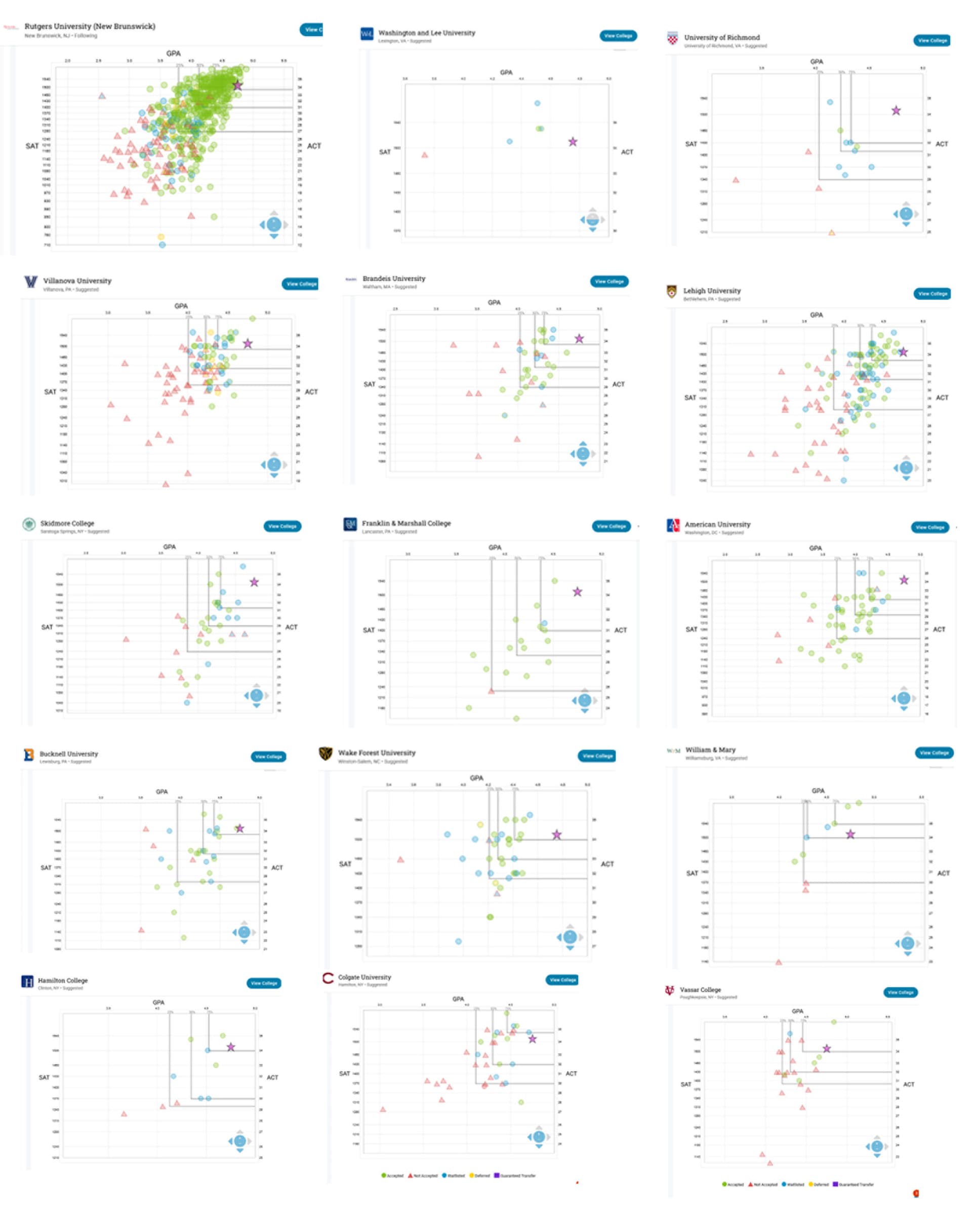
7 Likes
I’m not sure what you mean here. But while it is very tempting to assume that there is a “flood” of unqualified applicants, that is generally not the case. I can speak specifically to Brown (and your kid isn’t interested, so it makes for a nice test case). I am a relatively involved alumna, and have stayed involved somewhat in my regional admissions efforts.
There is very little doubt if you look at the statistics that the “rejected” and “accepted” pools look remarkably similar based on anything measurable.
Kid is the next Yo Yo Ma with respectable grades and scores? The kid is in, barring a felony conviction. But the “Yo Yo Ma” piece doesn’t show up in the macro analysis of who gets in and who doesn’t. Kid has a published novel (not self published, and parent is not a literary agent who pulled some strings) and respectable grades and scores? The kid is in, but you can’t tell from class rank or SAT scores who has a published novel which the Washington Post book reviewer says “reflects the voice of a new generation of literary sensibility” or whatever it is that future successful novelists have.
My point? Don’t assume that the kids who get rejected are unqualified. Yes, you’ve got the “Hail Mary’s” but they are not the bulk of the rejected pile. Don’t assume that a “plain vanilla strong student” is ONLY getting compared to OTHER plain vanilla strong students. Your kid will be evaluated in the context of the HS of course- you can’t ding a kid for not taking physics if the HS in Camden NJ hasn’t had a physics teacher in 5 years. But the general cohort of “kids like yours”-- that’s where the “unknowables” that are not caught by the statistics show up. Extreme artistic accomplishment, the kid who revamped your town’s solid waste disposal system which saved $2 million in its first year AND won your town a climate award from a sustainability-focused foundation… there is a lot of 18 year old talent out there which is not always reflected in the statistics.
Good luck-- I think your list is fantastic if Rutgers is a solid option. I am a huge Rutgers fan, and think if that’s the backup plan it’s a terrific way to go. BTW, Williams and Amherst should be classified with Columbia’s grouping-- unless your kid is a legacy. It is a self–selecting applicant pool so whatever wisdom you think you can glean from the stats is probably wrong. I know several kids accepted to Princeton or Yale who were rejected by one or both of Amherst/Williams. They know what they are looking for and having tippy top scores and grades are table stakes for them.
11 Likes
I’ve heard other parents say this and I don’t know where people get this idea…I’ve never heard any AO say this.
Yep, all this 100%. It’s always been one of my wishes that highly rejective schools post the stats of those not accepted.
The last couple of years I’ve read apps for a highly rejective school and before that was a college counselor. Once I had a view of the larger applicant pool…I was shocked at how strong it is, and I worked with some high stat students over the years. It’s impossible to appreciate unless you’ve seen it.
For OP, I would advise to run all this by the HS counselor because they are best positioned to categorize the schools on the list. Good luck!
7 Likes
Glad to hear this. I think the single safety strategy was the biggest concern that many posters had.
Best of luck to you and your kid.
7 Likes
[/quote]
I’m not sure what you mean here. But while it is very tempting to assume that there is a “flood” of unqualified applicants, that is generally not the case. I can speak specifically to Brown (and your kid isn’t interested, so it makes for a nice test case). I am a relatively involved alumna, and have stayed involved somewhat in my regional admissions efforts.
There is very little doubt if you look at the statistics that the “rejected” and “accepted” pools look remarkably similar based on anything measurable.
[/quote]
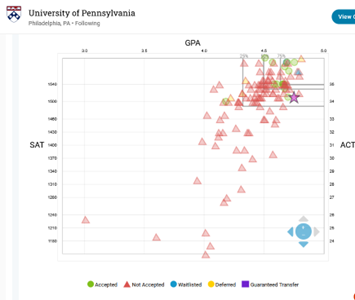
I would like to respectfully agree to disagree. Attached are the profiles from our high school to Columbia, Princeton, Penn, and Brown. I believe they reflect a pattern that may be similar nationwide. Everyone is free to draw their own conclusions. It’s unclear how many of those who were rejected had accomplishments like saving the town $2 million, publishing a novel, or achieving other extraordinary feats.



Just a couple more SCOIR rules of thumb from our feederish HS.
When your numbers look very good but data is sparse, in some cases you may need to start worrying about “yield protection”, where a college will waitlist or even reject a kid they think is very unlikely to take their offer. In my circles, some colleges are seen as doing this more than others, the better alternative being to instead offer merit and such. But some may need significant demonstrated interest, and indeed ideally sincere interest.
Another sparse data issue is that these are very likely shifting targets thanks to a number of ongoing dynamics. So even a couple cycles ago could start getting a little stale in some cases.
All this again supports being cautious about using sparse SCOIR data aggressively.
6 Likes