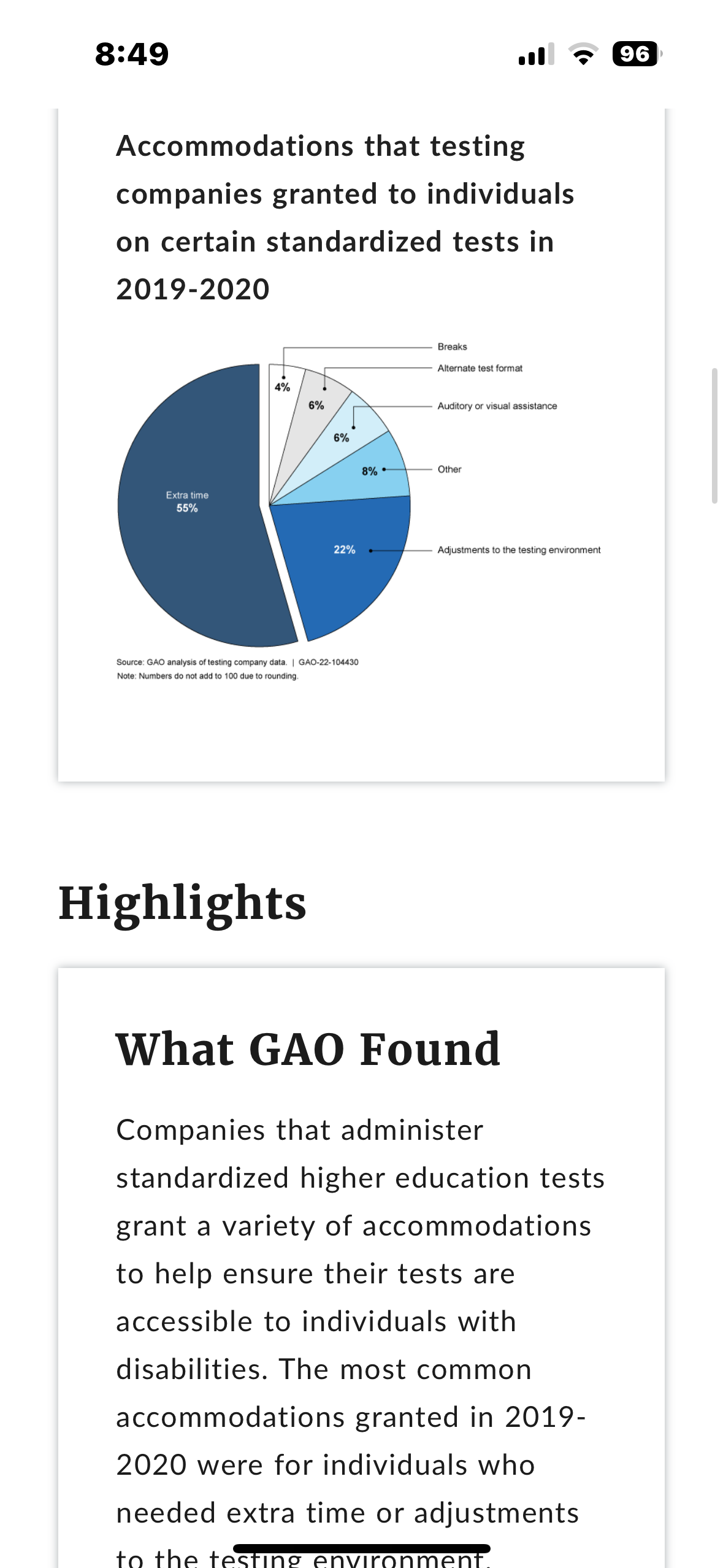
It’s interesting to see that many folks received accommodations for tests and exams. One of my nearest and dearest (ND) was formally diagnosed with adhd, inattentive type, at a young age. ND is about to graduate college. Every single teacher ND has ever had raised the issue of his ADHD behaviors. Early on there were accommodations of putting him upfront in class so the teacher could try to redirect his looking out the window. But no school or testing organization gave him accommodations on test, exams or papers. The schools posited that he did not need accommodations since he did well on tests and exams. And he did do well, considering. Certainly there was room for him to do better but apparently not enough of a difference that the schools thought he should get more time. In fairness, his ADHD is so profound that more time would likely not help in most situations. We focused on executive functioning, coaches, organizational coaches everything we could think of. Still, there is rarely a moment of ND‘s waking life that is not impacted by his neurodivergence. ND is one of the kindest, most warm-hearted people I know. At the same time people are constantly frustrated, if not angry, with ND. There are the emails, phone calls, deadlines, appointments he missed, failed to return, failed to meet, failed to show up for. Just walking down the street, there are the fellow pedestrians irritated when he accidentally absent mindedly bumps into them. There are the acquaintances, teachers, family members, potential friends whose feelings get hurt when ND does not do as neurotypical folks do.
Unrelatedly, from personal observation, students who need extended time for academic work should be cautious about assuming large amounts of debt for law school. I have seen talented graduates do quite well in school with accommodations, only to find the pace and client-driven deadlines of law-firm practice far less forgiving. There are many meaningful ways to be a lawyer, but the jobs that reliably support repayment of large student loans are, for better or worse, still primarily in law firms. Just my two cents!
Too much to answer in specifics but I would note that C26 has accommodations - which we got after paying dearly for a neuropsych evaluation that identified exactly what their issues were which the well-meaning but understaffed school counselors could not do. By the way, these accommodations do not include extended time on tests - it’s a fallacy that everyone gets this. Depending where they end up for college, there is a possibility that because the eval was done late freshman year, it will be older than the 3 years max a couple of colleges want and we might have to pay for another one to get some of those accommodations kept at college.
It would be nice if people who don’t have any familiarity with these processes don’t make sweeping statements about what they think are kids gaming the system. I’m sure some do, but don’t tarnish everyone. And to pre-empt other arguments, yes it is possible to effectively replicate some of these in a work environment without anyone really noticing or thinking it’s odd. (Do you ever notice anyone in an open plan office who wears noise-canceling headphones or if they are lucky can even find a hotel office to escape to when they need to work in a non-distracting environment? Some of our best analysts work like this.)
As for the increase in number of students - it’s pretty clear to me that the increase is likely related to the increase in diagnoses which, unless you have a brain worm, you will understand is due to better understanding of people rather than an actual increase in the number of people who have adhd, asd, etc.
The most important accomodation my AuDHD S24 has in college is a single room. It was strongly advocated for by his psychologist and pediatrician. He is now in a suite with 3 other kids, and having his own room allows him to live with others, share a bathroom, be social, and yet get the sleep and space he needs to recharge. He has mentioned his friends have so many different disabilities and accomodations that help them navigate and thrive in college.
Accomodations are so much more than just extended test taking.
I will just note that I would have strongly disagreed with this part of your statement before this year. Of course, everyone should be cautious about debt, so I don’t disagree with the general advice about debt. But going into public service or public interest was a great way for folks to go to law school, do meaningful work that often did not have the client time pressures you mention, and have your debt paid off. That was an avenue such a student could take. The Public Service Loan Forgiveness program was a way to do this. And, many schools had their own programs, usually requiring 10 years of service. I had my loans paid off this way and got to do meaningful work.
That said, given the uncertainty and volatility with our federal government at the moment, I’d hesitate to endorse this approach right now unless it is a solid school based one that works for the individual.
P.S. in your response to me you said it is interesting to see many people got extra time on testing. I want to be clear that I have not said that many people do. Others have said that here and I was responding to it. I do not purport to know how many or what percentage of the students with disabilities get extra time on tests. And consistent with the story you shared many accommodations are not that. Even testing accommodations are often a less distracting space or other things and not necessarily extra time.
Thank you for this post! Agree 100%. None of the people I work with know I have ADHD. But, an open space is a killer for me. Headphones, partitions so I can’t see people walking by which distracts me, and other little things made all the difference when I had one.
While the government accountability office table is a few years old, I did provide a link above about the percentage of a variety of accommodations. Extra time is in fact the most common (its probably also the most familiar to people).
Thanks for sharing this view, especially considering your ND is/was with ADHD. But I would think your concern about cost in law school may be valid for those with true ADHD/else, and other posters have also provided solid solutions for this. But for those who are exploiting the system, it does not matter, since they do not need it in the first place and they only use the accommodation to get some edge.
Our kids are always in public school, and cannot speak about private schools, although the NY post report from 2024 was about private schools, and another poster expressed his observation in his private school.
Our HS is a very competitive HS. I asked my S26 this morning, and he said in the class of about 300 kids, there are about two severe/obvious ADHD kids, and maybe 8 mild kids. And they have accommodations. Then there are five kids who get accommodation and they seem to be normal without any inside information.
One of his good friends is one of the two obvious cases. Even though he has accommodation, he barely used it. Maybe he did not receive enough treatment/coach to correct. He finished Eng/social study always fast and got bad grades and finished math even faster since he is great at math and received excellent grades.
I am wondering if (a big if) my S26 were admitted into Amherst or Standford or some similar schools and found 40% of peers have different accommodations and most of them is extra time. Will he feel more anxious and depressed (and how many not feeling anxious during each test)? Will he become one of those who needed accommodation to level the playground? Will this turn into a bad cycle?
As a society, it can only tolerate some kind of cheating. It can happen in education, then it can happen again in employment. Once it passes the tipping point, society may run into collapse.
Will point out that “the most common” at just over half is still far from almost everyone.
More to the point, perhaps, I don’t know that testing accommodations for standardized tests necessarily directly correlates to what the thread discusses more broadly which includes day to day life at a college - for example, it’s not going to pick up students who need a single room or disabled access to buildings, etc.
And I agree that extended time is probably most obvious to others so what people associate with accommodations, but there are a number of others both inside and outside a testing environment.
Yeah, my kid probably “seems normal” too, and that’s part of the reason it took us so long to figure out there was an issue. Disabilities are not always obvious.
It is by far the most common and the most commonly requested accommodation. The next one down (Modification in testing environment) accounts for less than half the number using or requesting extended time (for academic/testing purposes).
Speaking in generalizations (because no one on this board needs the specifics of my child’s disability nor their accommodations) - they receive 7 different accommodations.
Only two of those accommodations are in relation to testing.
Unless and until you are actually dealing with this situation, you don’t know. You may think you know pieces and parts. But you don’t know.
And you (the generic you, an individual), don’t have a right to know. It is literally nobody’s business but my child, their doctors and the Office of Disability what my child’s disabilities are. It has been incredibly offensive to read other people basically accusing students with accommodations of cheating or gaming the system. It is flat out wrong. And no one has produced a shred of actual proof. It has all been, “I hear so many people have accommodations and they look just fine” or “Why can’t we just say some people are stupider than others”.
Accommodations aren’t given to give students an unfair advantage or better odds. They are given to level the playing field, so everyone has the same equipment at the start of the game. Once everyone has the same equipment, then intelligence and hard work will be the separators of peoples’ performance not a disability they can’t change.
My child with a disability wouldn’t appear disabled to many. They are smart, kind, gorgeous, popular and do well in school. I would ask everyone to think about why that description or why students who appear that way would make anyone think they couldn’t have a learning disability? Or a health disability? What kind of wrongheaded and discriminatory views must one have to have such a clear idea in one’s head about who is disabled or that you’d be able to tell by looking at them? And that somehow they must present to others in a certain way to justify the accommodations that are necessary?
Two things can be true at once. There are many students who fairly need and deserve academic accommodations to do well. It can also be true that some parents will go to great lengths to secure advantages for their children, even when those advantages aren’t warranted. There are also a small number of doctors and psychologists who enable them just like the early days of medical marijuana legalization when certain doctors were willing to hand out cards to anyone for a fee.
Recognizing both realities is important. We can advocate for fair support for students with legitimate needs while also acknowledging that systems can be abused. Honest discussion about both sides is essential if we want accommodations to remain credible and not disadvantage students without them. I think most people in education see some abuse and it is frustrating. Educators want all their students to succeed, and they want a fair playing field for all.
In the academic environment, testing and classroom (not talking about other accommodations such as motorized chairs, weighted silverware, ABA therapist, emotional support animal, etc) from my experience, the most common requested accommodation was extended time (or time and a half or double time, as @shawbridge mentioned). Some request a quiet room (but as as noted upthread, those “quiet rooms” are now in some cases more busy than the standard room, at least in a testing environment), breaks, snacks, large print, a reader to read the questions aloud, a scribe, note taker or recording for classroom notes, modified test format (eg one question at a time), but many of these accommodations have been addressed by the availability now of digital testing. Some now also use headphones.
I’ve been trying to stay away from this thread because it feels like there is so much potential here for hurt feelings. And maybe I should’ve stuck with that, but this morning I just felt like I needed to chime in.
Just to offer one additional perspective:
Both of my children have profound and significant learning disabilities. Both, in fact, are enrolled in studies run by NIH associated with their particular challenges and, for my younger son, the lead research scientist has told us that out of the more than 2000 children with this issue (my younger started in the study at age 5, he’s 19 now) my son ranks among the top 5 or 10 most affected. Not five or ten percent, five or ten people. Out of 2000. If you ever met him, you would never know. You’d say he seems normal, that he 's just fine, that he’s smart and successful. You’d wonder if, because of our high socio-economic status we’re “working the system”.
That child refused to advocate to continue his HS accommodations in college. He was done with feeling different, and called out, and weird. He didn’t like having to talk with someone, to go to different rooms for tests (yes, he has testing accommodations among other things), to be treated differently in the classroom. He wants a refresh where no one knows. He’s done with the kids in his super competitive HS making sly comments about his high test scores and good grades being because he gets special treatment and not because he merited it. And you know what? He’s struggling with some of his issues in college. It’s harder than it should have to be. But unlike what some of the assumptions here seem to be (the “you’re a chump if you don’t take advantage” vibe) there is some shame with being different, and particularly if you get the feeling that people think you are “cheating”, and you aren’t. And he was done with feeling ashamed.
So please, remember, those kids that look “normal” or “perfectly fine” may have other stuff going on that you don’t know about and can’t see.
My other child tried to use his testing accommodations his freshman year - it involved being a different room. He found that the professor often gave corrections to errors on the test or relevant information to the students in the “regular” room that the students in the other room didn’t get. It happened often enough that he no longer uses the separate room accommodation as he felt it was actually damaging his chance for success.
Agree let’s not go round and round, but I think you may be missing my point. My point, having done these evaluations for many decades and followed the ADA policies , is what I have been trying to explain with respect to academic and testing accommodations. I have a relative who is a quadriplegic. The accommodations he gets are very different and do not need all this testing and documentation. It’s possible that several posters here have personal examples that address many other types of accommodations. My post about the most commonly requested testing accommodation was in response to this:
(emphasis mine)
There are some kids with specific math disabilities who may have needed an accommodation on only part of the test (that was challenging to request due to the nature of the testing environments). As for college accommodations, as I mentioned, one school offered a student the opportunity to bring their own mattress. There are accommodations for students with dysgraphia, with dyslexia, dyspraxia, dyscalculia, auditory processing disorders, non verbal learning disabilities, visuomotor deficits, executive function disorders, etc etc etc. But the most common accommodation requested (and commonly given) in the academic/testing environment is extended time. My personal favorite “many students with memory, attention, organization, executive function , ADHD or anxiety disorders, etc don’t know to request this accommodation” is to request having only one exam a day in college. Makes the lives of these students with these disabilities so much better.
My point, and experience, echoes exactly what @beebee3 and @OctoberKate are saying. I am simply addressing the post(s) upthread that asked or commented about the most common accommodation. I really think we are agreeing here. The whole point of accommodations is to provide EQUAL ACCESS, not to “game the system”.
As an aside, and in a related topic, in my community, there was one professional who was “known” to produce test scores for private school admission testing that seemed very high. Did that professional allow the student to reword their response more than testing guidelines allow or do some other interpretation of responses that benefitted the student? Who knows. But having spoken to some of the admissions folks at a local private school, that was reported as an observation several of the AO’s at schools made. As for “unscrupulous” testers, maybe there are some in my community, but fortunately I don’t know any (that I know of). As another side topic, there are now people evaluating students that may have less training/experience with the testing process and this could also lead to results that are questionable. But that’s a separate issue.
I will apologize in advance for wading into this thread with a question that may seem obvious. For receiving more time on a test, is there a reason why tests must be timed? I’ve often wondered what is the benefit of creating a timed exam, especially the standardized ones like the SAT & ACT, that prioritize speed of reading and calculation. What’s the societal/academic benefit of that?
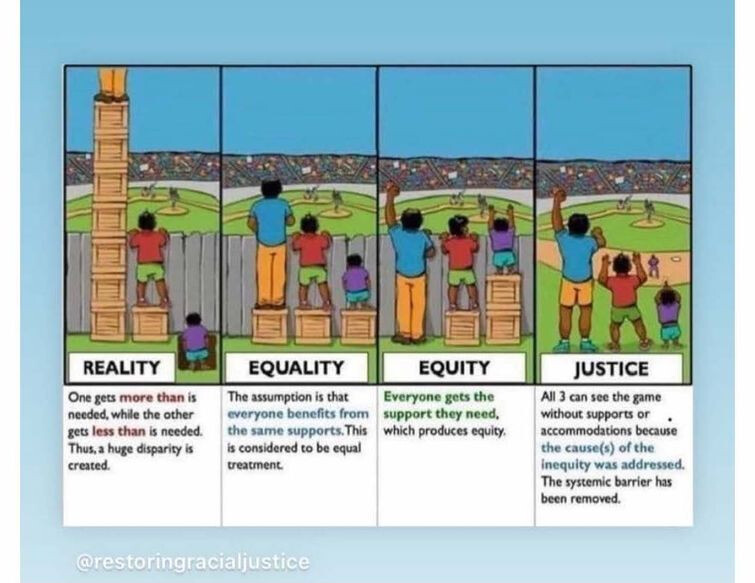
I’m reminded of this cartoon below. It seems like some of the accommodations discussed here about exam timing are about equity. Wouldn’t we all be better off seeking to move towards justice and remove barriers like time restrictions from exams?