<p>I think the problems will only get worse because Islam is itself deeply, deeply divided and is unable to deal with those divisions. Individuals saying things doesn’t change the institutional issues.</p>
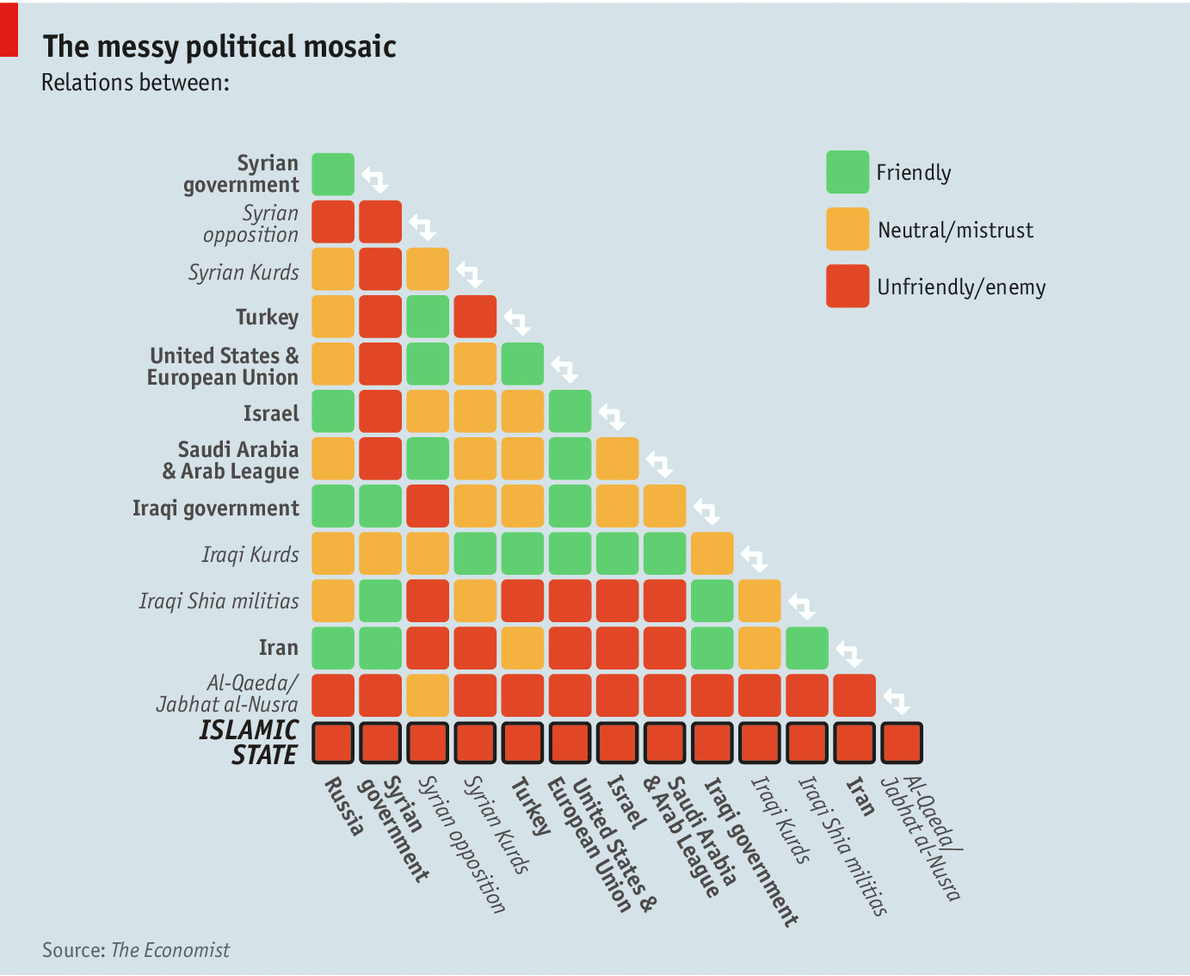
<p>On one level, much of the ISIS crap is Sunni versus Shia, as is much of the civil war in Syria (and indeed the relationship of Hizbollah to Assad to Iran, all being generally Shia). The oppression in places like Bahrain is driven in large part by Sunni versus Shia. But Islam still speaks of itself as a universal religion and there seems to be a tremendous pull towards ideas like a Caliphate which hark back to the era of Muhammed. In fact, ISIS specifically uses language intended to show themselves as the re-creators of the Islamic expansion after Muhammed’s death, though they are mostly busy killing other Muslims in the name of ritual purity.</p>
<p>At another level, Islam is over 200 years behind Christianity in questioning its own texts. I’m assuming Islam gets there, which isn’t clear. It’s very difficult to find scholarship about the actual origins and creation of the Qur’an or, as important, the traditions of the Hadith. Raising the topics can result in a death sentence for blasphemy or apostasy in nearly all the Islamic world - remember, converting out of Islam is a crime - and lately we’ve seen a number of so-called “liberal” scholars murdered in places like Pakistan. While some Christians of course believe in the unerring word of the Bible - though I must point out, I’ve never met one who has ever read a Jewish translation - the mainstream of Christianity has delved deep into the textual origins of the stories and, with some reluctance, discusses how these issues present themselves in belief as modern people see things, not as credulous people in the Dark Ages might have thought. </p>
<p>At a deeper level, the Qur’an itself repeatedly says it is without doubt and without ambiguity, though of course it is extremely ambiguous in many ways. I’d say each religion tends toward its core statements: Judaism towards the elevation of the commandments - meaning the entirety of the mitzvot, not just the 10 - and Christianity toward the elevation of the Son and the claim that the path to salvation is through the Son … and Islam to the literal wording of stuff written in an almost illiterate society nearly 1500 years ago. It’s a powerful pull toward the past. </p>
<p>And another, related level is the institutionalization of ritual rooted in the era of the Qur’an and near after. The veiling of women became a social constant in Persia but finds inspiration in Muhammed’s separation of his wives (if only to keep away gossip). All these rituals are embedded in cultures which are not only male-dominated but which are much more non-Western than Westerners can believe. As in, the number of books translated each year into Arabic is - per the UN - was less 10 years ago than the number translated into Greek. We’re talking 11 million Greeks versus hundreds of millions of Arabic speakers. (I suspect that Greece’s economic crisis has reduced their translation numbers but I don’t think the number translated into Arabic has changed much.) </p>
<p>But what happens is vague statements - see David Cameron - that “Islam is a religion of peace” and equally ignorant though perhaps less well-meaning statements that Muslims don’t condemn Muslim idiocy. Islam is not a “religion of peace”: it is for some but not for others. The truth of that is obvious. Christians don’t say “Christianity is a religion of peace” because they know many wars have been fought by Christians, often against other Christians and often because of Christianity. They may say “True Christians believe in peace” or the like but that’s a value judgement which reflects what that person or sect believes Christianity should be. The equivalent would be to say “Islam should be a religion of peace”. There are about 1.6 billion Muslims and it’s safe to say tens of millions of them are committed to conflict. Generic labels don’t begin to address the underlying issues. </p>
<p>And again, I see no capability in Islam to deal with these issues. Moderates are being killed or kicked out or are fleeing for their lives. The Arabic societies in particular have demonstrated they don’t have much to recommend them in any material way: the Arab Spring was actually the Arab Autumn and has progressed to the Arab Winter. Honor killings. Gang rapes of women. Driving out minorities. Killing minorities. </p>
<p>Let me mention one example: gang rapes of women. It’s not only a problem in Egypt and other Arab countries but it’s come out that Pakistani men in central Britain have been recruiting (i.e., forcing) teenage non-Muslim (i.e., British) girls in sex rings where men gang rape them. Not one. Not 10. Not 100. We’re talking 1400 teenage girls over a period of about 15 years. That’s nearly 100 new girls gang raped each year in a relatively small area in the middle of Britain. This could only happen in a Muslim community which has brought over and perpetuated its attitudes toward women and in particular its attitudes that non-Muslim women are fair game or prey. That could only happen if the British authorities turned their backs on this and let it happen. Rather than become Westernized, these Pakistani men brought Pakistan to Britain. Rather than integrate them into society, the British let them stay Pakistani. 1400 teenage girls. Think about that and what it says about that culture and then try to imagine how you deal with that in something other than vague words about “Islam is a religion of peace”.</p>